Tuesday, April 24, 2012

Neal Kirby Writes About His Dad Jack

"In 1961, I was the luckiest damn kid on my block — or maybe any block. My father worked at home. Everyone else’s dad had to drive into Queens or Brooklyn or take the train into Manhattan. And it was not some boring, old desk job; my father was Jack Kirby, the King of Comics, and — though his humble personality would have him cringing to hear this — he is regarded as the greatest comic book artist and creator – ever."

These are the opening words of Growing up Kirby: the Marvel memories of Jack Kirby's Son, an LA Times essay by Neal Kirby about his dad Jack "King" Kirby. Now, I don't usually gush but Neal's informative, heartfelt article  is a must-read for any self-respecting comic book and/or popular culture fan.

If for some reason the link doesn't work, just go to the LA Times website and search for "Growing up Kirby" there. You owe it yourself to read Neal's article!


Sunday, October 24, 2010

Mike Esposito, 1927-2010 -- of Andru and Esposito Fame and More

Sad news. Mike Esposito--that rose by many other names(Mickey Demeo, Joe Gaudioso, Mickey Dee)--passed away this weekend. Probably best known as the inker half of the fabled Andru-Esposito team, Mike had a long career working for both DC and Marvel. Andru and Esposito's classic Wonder Woman even adorns a US postage stamp!

Thanks for the enjoyment you brought to countless fans over the years, Mike--you'll be missed.


An Andru-Esposito favorite of mine was the Kanigher-scripted series "Rose and the Thorn", the back-up feature in Lois Lane for a while starting in 1970. Esposito has said he and Ross Andru envisioned the Thorn as a cross between Wonder Woman and Black Canary.

Lois Lane 105 Rose Thorn Andru Esposito
The Thorn in Lois Lane #105  - Art by Andru and Esposito


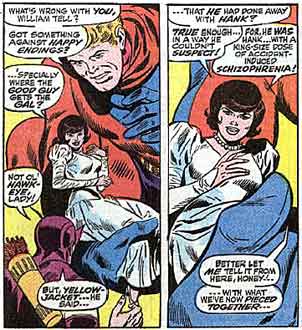
And let's not forget that Esposito was John Buscema's inker on the epochal Avengers #60, the wedding of Janet Van Dyne and Hank Pym.


For more on Mike Esposito's life and career, check out the terrific book "Andru and Esposito: Partners for Life", by Esposito and Dan Best. If your local comic book store doesn't have it, head on over to ever-reliable Amazon.

Tuesday, October 5, 2010

Alter Ego #95 Spotlights Not Brand Echh!...Plus John Buscema's Mighty Revengers

Silver Age fanatics should check out Alter Ego #95 for some great recollections by Roy Thomas, Marie Severin and others about Marvel's Not Brand Echh, the great parody comic book ("Who says a comic book has to be good??").

A line up of great artists drew for NBE, including Severin, Jack Kirby, and Tom Sutton. And speaking of great artists, take a look at this gorgeous page from NBE #12!

For more on Alter Ego #95, visit the TwoMorrows site at
http://twomorrows.com/

John Buscema Avengers
Avengers in Not Brand Echh #12 by dream team John Buscema and George Klein

Fun fact:  The Vision officially joined the team at the end of Avengers #58.  But apart from the very end of Avengers #60, this is the only appearance of the Wasp/Hank Pym Goliath/Hawkeye/Black Panther/Vision (core group) line-up! 

 'Course I'm talking about how it unfolded in comics back then; subsequent retcons and untold tales need not apply ;)

Tuesday, September 14, 2010

Kirby Covers! Top 5 On Sale in August 1961


Welcome to our Kirby Cover Countdown series!


To kick things off we'll take a look at the top 5 Kirby covers on sale in August 1961. Only the most exacting criteria--artistic skill, ambitiousness of concept, historical context, coolness of creature--was used to determine the final rankings. Here's how the chips fell:


5. Amazing Adventures #6
4. Journey Into Mystery #73

3. Strange Tales #90

2. Tales of Suspense #23

1. Tales to Astonish #25

Yep, you guessed it: our esteemed covers here were on sale around the same time as Fantastic Four #1. So I ask you: on that hot summer day in early August 1961, would you have noticed FF #1 among this panoply of Kirby covers?


Or maybe you would have ignored the FF, SSerpo, and Orrgo altogether...and instead used your hard-earned dime to buy our Honorable Mention in the August 1961 sweepstakes: Kid Colt Outlaw #101! (Hey, that Kirby guy didn't only draw monsters...)

Thursday, August 26, 2010

Happy Birthday Jack Kirby!


August 28th, 2010 would have been King Kirby's 93rd birthday.

Monday, December 28, 2009

Happy Birthday Stan Lee!


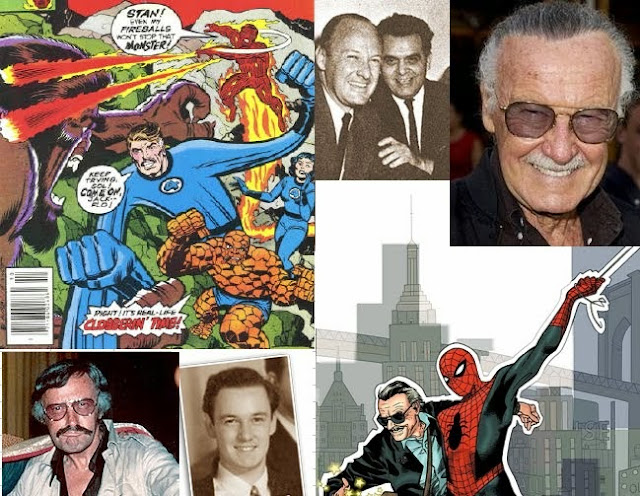
As I'm sure all True Believers know, December 22, 2009 is Stan Lee's 87th birthday. Comics as we know them would have taken a very different path if not for Mr. Stanley Martin Lieber, but then I don't need to tell you that--really, is there anything left to say about Mr. Stantastic that hasn't been said a kazillion times already?? (Okay, okay, so a lot of it was said by Stan himself--hey, he's not called The Man for nothing!)

Anyway, I'm getting a little verklempt, so let's all wish Stan a very Happy Birthday--hope it's a great one, Stan!


Stan the Man Marvel Universe

Tuesday, August 11, 2009

More Legion Lore: Teenagers From the Future!

Hi, guys and dolls...hope you're all sipping pina coladas and enjoying the beautiful summer so far. And let's imagine for the rest of said summer, you can buy only two more books about comics—well, it goes without saying one of them has to be Assembled! Volume 2, right? (Available on Amazon...check out our panel to the right for details!)

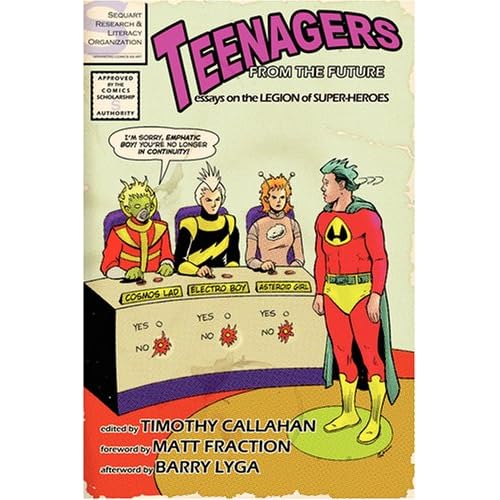
As for the second book, if you’re a Legion of Super-Heroes fan–and who isn’t?—do yourself a huge favor and grab a book called Teenagers From the Future. Like Assembled!, it's an anthology of essays, and also like Assembled! it's a great read: informative, enjoyable, and thought-provoking. I’m not exaggerating when I say that every single essay here is worth reading. You may not agree with the contributors' varied opinions and analyses, but you won't be bored--and you'll come away with an increased knowledge of the Legion's rich history.

Some background: Teenagers From the Future is a collection of essays edited by Timothy Callahan, with a foreword by Matt Fraction. The essays are presented in chronological order according to the Legion’s publishing history, so you get a good overview of the Legion oeuvre: the Silver Age Legion, the progression to the 1970s, 80s, 90s and so on, up through today’s Legion (and yes, the reboots are included).

The topics range from fairly standard (but still interesting) such as the “The Death and Resurrection of Lightning Lad” and “Women in the Early Legion” to the more esoteric “The Legion’s Super-Science” and “Decades to Get It Right: Architecture and Utopia” to the provocative “Diversity an Evolution in the Reboot Legion” and “The Racial Politics in the Legion” to…well, you get the idea. And what Legion tome would be complete without a piece on the Legion’s splendiferous sartorial style—so we get “Fashions From the Future, or ‘I Swear, Computo Forced Me to Wear This!’ "

There's commentary on the usual suspects including Mort Weisinger, Jim Shooter, Paul Levitz, and Mark Waid…but there’s also attention paid to the Legion’s earliest scripters Edmond Hamilton and Jerry Siegel. A minor quibble: I would have liked to seen an essay focusing on E. Nelson Bridwell (hey, Timothy Callahan, if you’re reading this and need an extra essay or two for your next volume…)

The book includes a fair number of reproduced panels and covers throughout (in black and white, alas) and there's a handful of factual errors, but it’s a very captivating read and provides a good basic overview of those kids from the future. If your local comic shop doesn't carry Teenagers, head on over to ever-reliable Amazon and order a copy. Happy reading!

Sunday, July 26, 2009

The Guardians of the Galaxy: Earth Shall Overcome!

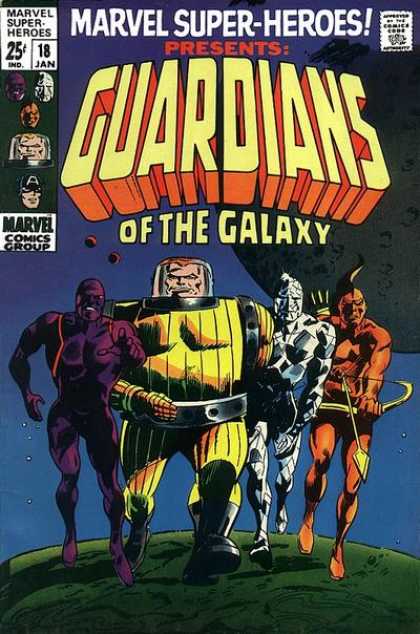
Marvel Super-Heroes #18, January 1969
Arnold Drake/Gene Colan-Mickey Demeo

I recently picked up the Marvel Premiere Hardcover, Guardians of the Galaxy: Earth Shall Overcome. I recalled the Guardians mainly from the pages of the Defenders, back in my early comics-buying days. When I saw that not only this collection was coming out, but its sequel (Guardians of the Galaxy: The Power of Starhawk), I was very excited to read them. I am a big fan of Marvel's recent strategy of getting not only important storylines from the Bronze Age back into print, but entire runs of short-lived series.

Since we tend to focus mainly on the Silver Age here at TGAGASC, I thought I'd stick to the first appearance of the Guardians from 1968 -- Marvel Super-Heroes #18 (cover-dated January 1969). The tale was authored by Arnold Drake and rendered by Gene Colan and Mike Esposito (under the latter's pen name of Mickey Demeo).

Arnold Drake, creator of the Doom Patrol and Deadman, was a longtime writer for DC Comics who fell out of favor with editorial toward the end of the 1960's. Shortly after seeing his workload dwindle to nothing, he moved over to Marvel Comics, where he created (with Colan) the Guardians. You can read more about Drake in a wonderful obituary penned by Mark Evanier at the following link:


I'll be honest -- this story reads just like a 1960's DC science fiction yarn! Colan's pencils (and I am speaking of figural form, speed lines, etc.) somewhat lend themselves more to the DC style than to what Marvel was then producing. Saying that, however, other than one splash page, there is not a single panel in the story that has right angle corners! Colan was really pushing the envelope with panel lay-outs here. Although there are no characters or backgrounds that break the panel boundaries (as we'd see a little later from not only Colan but also from the likes of Neal Adams, et al.), Colan's style is somewhat unnerving to the unsuspecting reader. A Colan-art veteran, I was nonetheless taken aback by the frenetic pace of the storytelling -- it was as if Drake's words could not keep up with Gene the Dean's pictures!


Drake's characterization is pretty basic. The bad guys, an alien race known as the Badoon, are pretty typically malevolent. They posture, they say all the right (or wrong, I suppose) things, and are pretty menacing in speech and in their looks. The goal of the Badoon is to eradicate the galaxy of humanity. On the other hand, the good guys fall into pretty basic team-book dynamics. It's difficult at this point to tell any pecking order among the four white knights, but it is pretty clear that Yondu the archer will be toward the bottom. I really had to laugh at the total lack of political correctness in Yondu's speech patterns -- reading him here was to "hear" Jay Silverheels speaking as Tonto! It really was funny. Vance Astro is a little bit of a smart aleck, and nowhere near the Captain America-clone he will become in subsequent incarnations of the team. Martinex is basically written as he will be later -- serious, focused. Charlie-27 is the one character who seems really undefined. He is listed as a survivor of the Jupiter colony, with a mass 11x that of an Earthman. However, the way Colan draws his head is quite odd, as it seems almost to flow -- it certainly changes shapes throughout the story. And, one would think that in spite of his bulk and weight that Charlie-27 possesses super-speed. He is drawn on many pages either with an overabundance of speed lines, and even at times in sequential pictures as if moving faster than the eye could normally follow -- as if he were Quicksilver or the Flash! I never remembered Charlie-27 possessing super-speed in any other stories, and indeed I can find no online references to that power in regard to his character. So perhaps Drake/Colan wanted to tinker with this later...


And that "later" wouldn't come to pass anytime soon. The Guardians, after their one-page, cliffhanger first appearance, would be back-burnered until Steve Gerber chose to unshelve them in 1974. After that, they would appear somewhat regularly as guest-stars in Marvel Two-In-One and the Defenders (1975), before gaining their own series in the pages of Marvel Presents (1977).

If you're a fan of the Bronze Age, or of science fiction, or just of today's Guardians (which I admittedly know nothing of), then you should seek out this hardcover. For my money, I wouldn't plunk down any change just for Marvel Super-Heroes #18, but for the added content the collection was the way to go.

Sunday, July 12, 2009

You've Lost That Loving Feeling...

It's tough these days for a fan of the Silver/Bronze Age. Contemporary comics, while they may be prettier to look at -- the art is certainly more complex, and the color palette available boggles the mind -- don't have the overall substance that those stories of yore brought to the reader each month. While there are a few modern books I enjoy, I often find that it is those stories with sort of an "old school" feel that make me smile -- and for the prices the publishers want these days, it would take a little effort to smile! Current trends of decompressed storytelling, anatomically incorrect art, and meandering plots just leave me cold. So, what I'd like to do here is spend a few minutes recommending some books from the past 15-18 years that can bring you back to those good times.


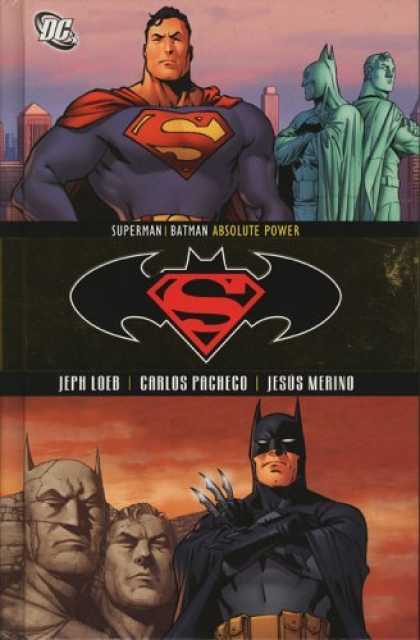
Superman/Batman: Absolute Power. Jeph Loeb, Carlos Pacheco, and Jesus Merino

Reprinting Superman/Batman #14-18. Published 2005 and MSRP $12.99


A lot of people knock Jeph Loeb, and I would never say that modern knocking of him isn't justified -- one need only look upon the trainwreck that was Marvel's Ultimates, Volume III to see what this man wrought on Earth's Mightiest Heroes. Yuck! However, I have largely enjoyed much of his writing on Superman/Batman and this volume is perhaps my favorite in the series of trade paperbacks. It certainly doesn't hurt that the art by Carlos Pacheco is every bit as good as his masterpiece that was Avengers Forever. The back cover tells the gist of the story:


"The Earth wakes up one day to a brand-new world order -- one in which Superman and Batman rule with an iron fist. Humankind has a choice: obey or die. How did things get this way? And is anyone left who can stop them?"

Loeb pens a really fun tale. It's what back in the day would have been called an "imaginary story"; perhaps in the language of today it's an Elseworlds story. The synopsis above is the thread that runs through most of the book, but what a tour de force of DC history this book is! From the Legion of Super-Villains to Uncle Sam and the Freedom Fighters, from the Mike Grell-era Legion to Kamandi, from Sgt. Rock to the Haunted Tank and then on to the Adult Legion, Loeb romps through the 1970's in a really fun, fast-paced story. I highly recommend this as a wonderful nostalgia trip!


The Adventures of Captain America: Sentinel of Liberty. Fabien Nicieza, Kevin Maguire, Kevin West, Steve Carr, Terry Austin.


Four-issue prestige-format series, published in 1991-92; has not been collected in tpb format.

Can anyone out there tell me, with all of the CRAP that gets collected into a trade paperback, why this story still languishes in four prestige issues?? This book is wonderful!! I can't recall very many times in the past 20 years when I have enjoyed a book this much. First of all, I love Kevin Maguire's art -- I have since the Justice League's post-Crisis days. And Maguire's style fits Fabian Nicieza's story to a T. However, Maguire moves to "storyteller" credit in issues 3 and 4 as Kevin West and Steve Carr take over the penciling. Inks throughout are by Terry Austin, who gives the book a consistent look. Much of the appearance that modern readers would associate with today's Ultimate Captain America is here -- the pronounced chain mail and the helmet most notably.


If you are at all familiar with the serialized movie adventures of 1940's action heroes like Flash Gordon, you'll really take to this tale. Each book ends with a cliffhanger, and all of the intrigue of WWII, Hitler, and of course the Red Skull are here. Great stuff, and I'd imagine that through either the back issue bin or eBay, you won't have to pay much over the $5 cover price. Check it out!!


JLA: Liberty and Justice. Paul Dini and Alex Ross.

One-Shot, Treasury-sized. DC Comics, November 2003. MSRP $9.95 at the time of publication.


The dedication of this volume, one of many books in the Paul Dini/Alex Ross collaborations that began with Superman: Peace on Earth, is to 1970's Justice League of America artist Dick Dillin. This couldn't be more appropriate, as Dini and Ross weave a tale of the JLA of that era. This is a younger JLA; Aquaman has both hands, Barry Allen is the Flash, and there is no gray on Hal Jordan's temples. As such, it's a JLA bereft of some of the post-Crisis baggage and it is better for it. This story follows the original seven, but includes enough cameos and guest appearances to satisfy any fan of Bronze Age DC Comics. The basics of the story are found on the book's back cover:


"In JLA: Liberty and Justice, the League confronts a threat from space, but a much different menace from those they have faced before. This new danger arrives on our planet in the form of an alien disease -- a cellular composition unlike anything on Earth, deadly to all who come in contact with it. The virus spreads quickly, setting off a chain reaction of global fear and panic. Soon the Justice League themselves are under suspicion -- are they ultimately responsible for this alien danger? Before long, paranoia, distrust, and an ensuing wave of hysteria threaten to rip the world apart."

Great stuff --fast-paced writing, and Alex Ross' art is never hard on the eye. Appearances by Green Arrow, Hawkman, the Atom, Black Canary, and Plastic Man (among other cameos) really make this a fun read!


Sunday, July 5, 2009

Magneto: Testament
Historically Useful, or Travesty to Memory?


In my love for comics, specifically men in spandex (super-heroes, you know!), I rarely take the time to "get out of the box". Occasionally I'll try some sword and sorcery, or even some comedic material like Bone. But one genre of comics I usually seek out and make time for deals with another passion of mine, and that is study of the Holocaust. In my spare time, I am an educator with the United States Holocaust Memorial Museum, and I travel the country (and even beyond at times) teaching teachers how to deliver this subject matter to secondary-aged students.
I use Art Spiegelman's Maus with my own freshmen-level classes, and I've cited that graphic novel as well as Will Eisner's The Plot (an extensive look at the writing and desemination of The Protocols of the Learned Elders of Zion) in my senior-level Social Injustice class. I just finished reading Magneto: Testament, and I want to recommend it to you. The edition I read is hardcover, runs $25 retail, and reprints the five issues of the mini-series that was published in 2008. It also includes historical endnotes and a teacher's guide. While I didn't wholeheartedly agree with all of the lesson suggestions, it would still be a welcome resource for many educators.

If for some reason you aren't up on your X-Men lore, or if you haven't seen any of the three X-films (and my main question would be -- why are you reading this blog if you are in the dark on the X-Men??), Magneto is the main bad guy in the mythos. He is a tragic hero, bent on making the world safe for those with mutant powers. He has been shown at times to be quite militant, and is opposed by Professor Charles Xavier and his X-Men; you might think of Malcolm X's means for achieving racial equality vs. Dr. Martin Luther King's means; you'll get the basic story. Make no mistake -- just above I stated that he is a "tragic hero". That's somewhat of a newer characterization, as throughout the Silver and Bronze Ages Magneto was one of the premier do-badders in the Marvel Universe. He left a body count, to be certain. But, around 30 years ago, Chris Claremont (and subsequent writers) decided that a way to explain Magneto's militancy in the mutant vs. non-mutant conflict was to set his origins in the Holocaust. Magneto: Testament is the definitive origin/backstory of the character.

While this graphic novel could be used in any high school class-room, and is a serious and straight-forward look at a German-Jewish family and their lives before and during the Holocaust, I'll recommend it, too, as a fine read for the comics enthusiast. The first thing the reader of this story might assume is that Magneto is going to use his powers against the Nazis as was shown in the first X-movie. However, as a boy in this tale, Magneto exhibits virtually no powers, so this truly is a Holocaust story and not a superhero story in any way. The author and artist (Greg Pak and Carmine Di Giandomenico) were edited by scholars at the Simon Wiesenthal Center; I can say that everything they wrote/drew is accurate to the best of my knowledge -- the Auschwitz I and II scenes are outstanding. I was able to travel to Warsaw and Krakow, Poland last October -- my journey included a tour of Auschwitz I and Auschwitz II-Birkenau. The author/editor of this graphic novel use the book's endnotes to offer specific support for many of the scenes in the story. I felt good that what had been presented was rooted in actual events, a danger that historical fiction often faces (and often loses, in my opinion). I did somewhat cringe, though, at a scene (panel, actually) that was right out of Schindler's List (when the women are on the train bound for Auschwitz).

The basic plot of the story follows young Max Eisenhardt (Magneto) as the Nazi noose around the collective necks of the Jews of Europe tightens. From the Nuremberg Laws of 1935 to Kristallnacht (November 9-10, 1938) to the invasion of Poland, and of the USSR (June 1941), Max is thrust into the middle of events he cannot control. Compounding his problems is his budding love for a young Roma (gypsy) girl named Magda. The tale is fast-moving, historically accurate, and a page-turner of excellent characterization and suspenseful story-telling.

Magneto: Testament is a much shorter read than Maus, and probably more accessible to youngsters than The Plot. It is graphically violent in spots, but then I would add that no student of the Holocaust would be surprised at any of the situations depicted. I'd rate the book PG-13 I suppose, but there is more than that implied at times. Of course, with as much violence as generally makes its way in between the pages of the standard 20-page comic these days, perhaps no one will be surprised. I'd offer, however, that "real" violence -- that based on historical fact and in real-world events -- carries a bit more weight, even shock value.
So, if you have time to waste someday at a Barnes and Noble or Borders... or if you will actually part with your hard-earned cash, I'd recommend picking up this collection. I wanted to also give you a head's up that this could prove to be an exciting new resource for secondary teachers.

Note: The trade paperback collection was solicited in Marvel's section of the June Previews.

Thursday, June 4, 2009

Feel Good That You Bought It


Stan’s Soapbox: The Collection


Over 14 Years and Over 46,000 Words of the Wit and Wisdom of Marvel Comics’ Stan Lee


Brian Cunningham, Managing Editor and Copy Chief


HERO Initiative

MSRP $14.99


Doug: This week we continue our off-and-on series of book reviews spotlighting various comics’ histories/artist profiles. Stan’s Soapbox: The Collection is just that – a chronological reprinting of Stan’s columns that ran on the Marvel Bullpen Bulletins pages from 1967-1980. The book is published by the HERO Initiative, which is a charitable organization benefitting aging comics creators who have fallen on hard times. Stan Lee has long been known to have a heart for those who went before him, and even those who were his contemporaries. It’s no surprise, then, that he loaned his name as well as a small slice of his work to this project.


Doug: As we’ve done in the past with our looks at the Marvel Chronicle and John Buscema: A Life in Sketches, we’ll give you the lowdown – good and bad – on the book. I say that with somewhat of a bad feeling; after all, the book is for charity – and a great cause at that in honor of so many men and women who’ve given comics lovers so much joy through the years.


Doug: Stan’s Soapbox is a fun trip down memory lane. For those of us who grew up in the late 1960’s or 1970’s, this book really takes the reader back to those times. On the back cover, Stan is referred to as “the P.T. Barnum of comics”, and that characterization certainly shines through over the time covered between these pages. Huckster, spin doctor, even philosopher – all sides of Stan are on display in his columns. And that’s the brightest part of the book – we see Stan as the world’s biggest Marvel booster. He connected with Marvel’s fans by writing to them – the reader felt as if Stan was speaking directly to them. I wanted to be a part of what Stan was telling me – I wanted to know the creators of whom he wrote, to own the books Stan was plugging, and to consider the social commentary of which Stan sometimes soliloquized. Stan Lee was the difference between Marvel Comics and DC Comics in the time period covered herein – where DC seemed sterile and afraid to take risks, Marvel continued to redefine the industry with its forays into different genres, formats, and media. And Stan was always at the front, letting us in on the scoop ahead of everyone else. Or so we thought…


Doug: And herein lays the main problem with the book – its organization by cover date.

Sharon: Yes, as I’ve noted offline, the issue of the cover dates bothers a stickler like me. Simply put, the dates ascribed to the Soapboxes aren’t entirely accurate. Some background: in the mid-1960s, Marvel comics that were on sale at the same time were either cover-dated 2 months ahead of the actual release month (Avengers, X-Men, Daredevil, FF, Thor, Sgt. Fury) or 3 months ahead (Fantastic Four, Spider-Man, Tales to Astonish, Tales of Suspense, Strange Tales). This tiered approach means that’s what’s labeled in the book as the July 1967 Soapbox would have appeared in the July 1967 Avengers, but not in the July 1967 Fantastic Four; instead, the book's "July 1967" Soapbox would have appeared in the August 1967 issue of FF. This may be confusing to the diehard fan that may want to check out the Soapboxes in the original issues of FF, Spidey, etc. To be fair, the provider of the Soapboxes (Charlie Novinskie) does state he'd scanned the Soapboxes from his very own Avengers collection (with some Spideys thrown in). Also, some Soapboxes are missing, such as the one that would have appeared in the June 1968 Avengers-X-Men-etc./July 1968 FF/Spidey and so on. I guess Charlie didn’t have a copy of Avengers #53 in his collection!


Doug: A word about the format of the book: Stan’s Soapbox is a very colorful, eye-grabbing book. Until about 2/3 of the way through. I wonder – did the budget start to run low? Because the first part of the book is filled with lots of color, period art, and even the actual yellow-boxed columns reprinted alongside the newly typeset material. The latter pages, while giving us the material promised, just become bland – it’s as if the extra effort to make it a homerun just stopped. Troubling…

Doug: A comment on the Soapboxes themselves: Stan often pitched upcoming products, some of which never materialized. A nice touch would have been to have some historical information, to see what happened to those ideas that never saw the light of day. In addition, I felt like additional commentary as far as market reports, etc. would have benefitted some of Stan’s points – the reader is often left just scratching the head. So instead of just reprints of Stan’s columns, we could have been given an in-depth look at one corner of Marvel Bronze Age marketing.


Doug: So what’s the conclusion? Should you buy this book? Let me say that I am not sorry that I own this.


Sharon: Neither am I. Despite the layout and the date issue I mentioned, and the fact that many of the photos and graphics are available elsewhere, this is still a worthwhile book for any Marvelite. And I’ve never seen the great photo of Lee and Kirby on page 19—I got a real kick out of seeing that!


Doug: As was stated at the top, it is for a charitable cause, and is a small way for me to say “thanks” to those who’ve given me so much four-color fun over the course of my 35+ years of reading comic books. It is handy as a source to read the columns, even though I have some of the Marvel DVD-ROMs and own a complete collection of all of the Bullpen Bulletins therein. We have also recommended on the right sidebar of the blog the Bullpen Bulletins webpage, located at http://www.costa.lunarpages.com/bp/bullpen.html. If you are close to a computer and want more of the total feel for Stan’s promotion then that is a wonderful resource to consult. But if you are strictly looking for some illumination of Stan’s thought processes, maybe that new nugget about Marvel history in the 1960’s-70’s, then you are going to be disappointed.

Related Posts Plugin for WordPress, Blogger...