Showing posts with label Joe Sinnott. Show all posts

Wednesday, September 9, 2020

Call Her Crystal! Part 1

I've always loved Crystal and her bright orange hair that had that cool I-think-it's-a-black-headband/decoration. But did you know that her trademark headband wasn't part of her original look? You didn't? Well then,True Believers, time to take a closer look at    Crystal in the Silver Age!
Fantastic Four 45 Inhumans Crystal
Unless noted otherwise, all art is by Jack Kirby (pencils) and Joe Sinnott (inks). 

Fantastic Four #45 - Crystal's debut  
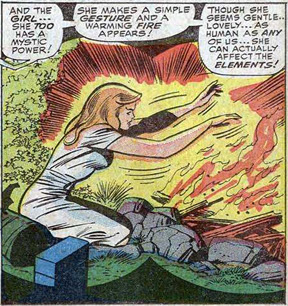
Initially Crystal sported a mane of long, tangerine-colored, unfettered locks. No headband!
Crystal Johnny Fantastic Four 45
(1965) Fantastic Four #45

Fantastic Four 45 Inhumans
(1965) Fantastic Four #45 
You can also see her eyes are somewhat exaggerated, with a definite upwards tilt and extra eyelashes. Her eyes are  shaped like fish, complete with little fins and a tail. Also, her brows veer upwards in dramatic Namor-like fashion.
Fantastic Four 45 Crystal Johnny
(1965) Fantastic Four #45
Along with her sister Medusa, Crystal was one of the few Marvel characters back then who had really long hair. Okay, besides Thor. 
(1965) Fantastic Four #45

Fantastic Four #46
She retains the fish-shaped, ovally eyes and ascending brows on the cover...

Crystal Fantastic Four 46
As above: Crystal close-up from cover of Fantastic Four #46 (1966)

...and also within the story. Her antenna-like eyelashes are again emphasized.
Lockjaw Gorgon Crystal Medusa Karnak Inhumans
Crystal, Lockjaw, and the Inhumans on the run in Fantastic Four #46 (1966)

Fantastic Four #47
Here Crystal's eyes are now closer in appearance to Sue's or other Kirby women--that is, her eyes are not so dramatically tilted and they're sans the extra eyelashes.  Her brows are now more horizontal.

Karnak Crystal Medusa Inhumans
(1966) Fantastic Four #47

Fantastic Four #48, #50, #52
Crystal shows up in a few panels in each of these issues. 
Fantastic Four 50 Inhumans
(L.) Fantastic Four #48, (C.) Fantastic Four #50, (R.) Fantastic Four #52 

Fantastic Four  #54
On the cover she almost looks like a slightly longer haired Alicia (from FF #41, Kirby inked by Vince Colletta).

Fantastic Four 41 Alicia Masters
L. - Crystal by Kirby-Sinnott Fantastic Four #54 (1966)
R. - Alicia by Kirby-Colletta Fantastic Four #41 (1965) 

In #54's story, Crystal's bangs are now sideswept.
Fantastic Four 54 Inhumans
(1966) Fantastic Four #54
It's the same sort of Kirby Krest found on Sue, Alicia, Jane Foster, Betty Ross, Marvel Girl/Jean Grey, and other women by Kirby in the SIlver Age. And yes, occasionally on Thor too (don't worry, we'll take a closer look at the Kirby Krest later on 😁).

Fantastic Four #56
As is obvious in all of these appearances, Crystal didn't have a colorful costume like the rest of the Inhumans royal family. Instead she wore a plain white dress. But surprise! In #56 she appears in a panel or two wearing a fuchsia-colored dress. Guess that's the day the white dress was at the Attilan dry cleaners. (Karnak's costume's coloring is off-model in that issue too.)
Fantastic Four 56 Black Bolt
(1966) Fantastic Four #56 

Fantastic Four #57, #59, #60
She's back in that white dress. Coiffure-wise, her Kirby Krest seems to be a fixture. 
Black Bolt Fantastic Four 57
(1966) Fantastic Four #57

The Inhumans break free! 
Fantastic Four 59 Crystal Black Bolt
(1967) Fantastic Four #59

Fantastic Four 59 Inhumans
(1967) Fantastic Four #60


NEXT:  The Headband Cometh! 
or   Crystal: I Am Curious Yellow

Friday, February 6, 2009

Family Matters: The Fantastic Four's Triumphs and Tribulations, part 6


Part 6 – Breaking Up is Hard to Do


Fantastic Four # 149
August 1974

“To Love, Honor, and Destroy!”

Gerry Conway, Rich Buckler, and Joe Sinnott


Doug: What a great splash page! As we go through these issues, I find Rich Buckler to be either home run or so-so. I really think this splash, with its triangular orientation of figures, the dynamic poses, and the intensity of Namor’s posture to be fine rendering. Sue looks good, the lackey looks menacing, and you just can’t beat a good ol’ battle cry: Imperius Rex!

Doug: Hmmm… about Page 2. Reed’s in character – tense, willing to fight (although as my colleagues have argued in prior postings, is it “too little, too late”?), Ben’s for the most part in character… but something about Johnny’s take throughout this has bothered me. I have wondered where the “blood is thicker than water” instinct is. To me, Johnny should have remained loyal to Sue. I understand why Ben has stuck with Reed, and Medusa is caught in the middle but with her loyalty being toward service to the team. Johnny just seems a little dense in regard to the magnitude of the decision Reed made about Franklin.

Karen: Well, Johnny’s always been a bit dense, hasn’t he? What really creeped me out was his thought in the previous issue, about a sister being “almost as close as a wife”. Uck.

Doug: Medusa using a little of that “woman’s intuition”? What did you think about her line that Namor has never been vicious? Hel-lo!! Ever read any Golden Age books, Sweetie?

Karen: The whole thing with Medusa is odd, until the reveal at the end. This picks up on the Medusa-Torch story from a few issues back, where they were going to the Hidden Land, because Blackbolt had called for her - hmm, they never did get to Attilan. Geez, Conway really did drop a lot of plot threads!

Sharon: Let me get this straight—back in FF#145, Reed tells Medusa he received a message for her from Black Bolt about a “Project Revival.” In light of the reveal in #149, it seems like the mention in #145 was supposed to be a signal to her that this plan is being set in motion. So why does she act like she’s all of a sudden figuring things out in #149?

Sharon: And if “Project Revival” was a really plan to get Sue and Namor back together, why did Reed tell her Black Bolt wanted her back in Attilan, and why did she go through the trouble of dragging Johnny along with her? And then after the mayhem that ensued (in #145 and #146), their trip to Attilan was then dropped—so poor Johnny didn’t get to see his beloved Crystal before her wedding after all. It appears Stan was not the only one with the faulty memory back then, eh, Roy Thomas (editor) and Gerry Conway (writer)?

Doug: As the battle begins, I’m thinking of that mid-80’s series Damage Control. When these super-powered types get after it, there is a lot of destruction that takes place! And how about the taxpayer bill, for the police, etc.?

Karen: Apparently folks like Blackbolt and Namor don’t concern themselves over such things – I mean, why have Sue and Reed sit down and talk when you can destroy half the city instead?


Doug: “Sue’s force field – It appeared so suddenly, there was no time to swerve away!” Umm… appeared?

Karen: Reed must have had his special invisibility detecting glasses on….


Doug: I thought Ben’s trip down memory lane was well-crafted and a very nice addition to the story. Sometimes I don’t care for flashbacks – seems they just take up space. But this fits perfectly, and Buckler’s art reflects an early Silver Age feel during these panels.

Sharon: Buckler does a nice job here recreating the Kirby scenes from FF #4—an instance in which swiping is appropriate and is, in fact, expected.

Doug: There are some really outstanding splashes and two-page splashes in this little arc.

Doug: As for the battle, I became aware that most of the fighting was mano a mano – not a lot of property destruction. It began to seem like something was amiss. Although no one on the FF’s side ever spoke of Namor pulling his punches, I just had to wonder what was really going on.

Doug: The conversation between Ben and Sue was great – in my opinion, this type of writing is lacking in many of today’s comics. These panels conveyed a history between these two characters, a depth of emotion that seemed real. Today’s comics often just run from battle to battle with a cheesecake shot in between with no real concern for character development.

Karen: I’d agree that I’d like more interaction between characters in today’s team books, but honestly, Sue’s reaction to Ben’s comments just seemed a little too convenient. She’s felt that Reed is distant and neglectful, but because he’s willing to fight over her, suddenly she’s back in love with him? Then again, people are unpredictable emotionally. So I’ll let it pass.

Doug: The big reveal at the end was a nice surprise, although I did feel that Medusa’s role in it remained unclear and somewhat clumsily handled. It was good to see Triton, and the proximity of this story to the coming wedding of Crystal and Quicksilver seemed to dovetail nicely.

Karen: Yes, the whole Project Revival idea here (with the Inhumans and Namor teaming up to get Reed and Sue back together) seems about half-baked. Namor in particular seems out of character. It feels like Conway didn’t have a good idea of how to achieve the couple’s reconciliation, so he just threw in a big fight and poof! They love each other again.

Doug: Overall, this last arc was a fun, sentimental read. Looking at it in a short timeframe, I’m still uncertain as to why Conway chose to insert the Frightful Four fight in between the stories in #147 and #149 – perhaps that was the only vehicle he could think of to get Thundra into #149? And she proved indispensable to the events concluding this issue, as Conway chose Ben to be the one to reason with Sue – someone had to occupy Namor so that Ben could steal away.

Doug: As to an impression of this entire series, it has really been a nice trip through Marvel history, and is a summation of why Marvel has for years been (in my opinion) so far ahead of DC. Marvel took the time to craft an inter-related universe with “real” characters – people with feelings, emotions of pride and resentment, and life events that occur in the everyday world.

Karen: It seems to me that the Reed – Sue breakup started out pretty well, but sort of fell apart here at the end. The early issues (even before the ones we reviewed) gave good reasons why the split occurred –particularly after Reed zapped Franklin. But these later issues never truly felt solid; they seemed to be poorly developed. While attempting this type of subject matter was laudable, the execution of the story was lacking.

Karen: And speaking of Franklin – where the heck was he all this time? Sitting inside Namor’s ‘Tomazooma’ fortress? I’m surprised Sue would let him out of her sight!

Sharon: Maybe she made him invisible, to keep him out of harm’s way? ;)

Friday, January 30, 2009

Family Matters: The Fantastic Four's Triumphs and Tribulations, part 5

Part 5 – Marital counseling – Marvel Style

Fantastic Four # 148

July 1974

“War on the Thirty-Sixth Floor!”

Gerry Conway, Rich Buckler, and Joe Sinnott

Doug: Near the end of this story, Gerry Conway refers to this issue as an “interlude”, “a brief respite… between one tempest of emotions and the next”. Boy, would I agree! This story, while OK, just comes at the reader right out of nowhere. Not having read this in many a year, I’d forgotten that this was a part of our little Subby hate-fest!

Karen: I don’t know why this story was in #148. It makes no sense to me. If he wanted to do a Frightful Four story, why not put it in 149? I’d love to know why it was felt necessary to wedge this in between the parts of the Namor story, because it really feels awkward.


Doug: I guess the standout points in the story are the plot gaps. From the splash page on, I have several bones to pick – we don’t know why the FF left Namor’s undersea fortress, we don’t know how the sideplanes on the Fantasticar were restored (Johnny had intentionally wrecked one when attacking Namor), we don’t know how the Frightful Four infiltrated the Baxter Building, and we don’t know why or how Thundra shows up to rescue the FF (even though Reed specifically asked her). So while this book is a fun battle royale between the FF and some classic villains, it seems to be in the way of the greater, more pressing resolution of the Reed/Sue/Franklin/Namor situation.


Karen: Doesn’t it seem weird how Thundra keeps popping up during Conway’s run? Every time she shows up, she makes some statement about how she’s going to eventually beat the crap out of Ben, then helps the FF, and disappears! I wonder if Gerry or Roy really knew where they were going with her.


Sharon: It would have been interesting if the powers that be had developed a Ben-Thundra romance. I get a kick out of Thundra's attraction to, or fascination with, Ben. 


Doug: We’ve mentioned other writers’ “pets” – Englehart’s use of Mantis, etc. Perhaps Thundra was Conway’s pet character.

Doug: I thought the Sandman was done really well in this story. Conway did a pretty good job with the dialogue between ol’ Flint and the Thing. The Trapster and the Wizard, on the other hand – I just can never seem to take these two guys seriously. I just know that it is only a matter of time (and usually a short time) before they get their butts kicked!


Karen: Agreed – Wizard always came across to me as a third-rate Reed, and a whiner to boot. As for Trapster, I could never figure out how a guy with the apparent IQ of a honey dew melon could devise all those gadgets. The only time the Frightful Four seemed like a legitimate threat was when they brainwashed the Thing, which says a lot more about the Thing than it does about these villains.

Sharon: The inclusion of the Frightful Four just seemed like Marvel’s (Roy’s?) calculated way of evoking the “good old days”, back around FF #36: the intro of Frightful Four and Medusa…which led to the Inhumans, Silver Surfer, Black Panther, and so on…the timeframe which many feel were the glory days of the FF.


Doug: The ending 2-page splash with Namor was impressive, and I suppose more so because of the interlude. Maybe this was Conway’s method of allowing not only the team, but the readers, to recharge before the grand finale.

Karen: This issue doesn’t progress the Reed-Sue story at all; it’s basically one long fight scene. It’s a shame; I would have liked to have seen more introspection on the part of our fabulous foursome. Maybe some behind the scenes stuff with Sue and Namor too. All in all, this issue doesn’t have much to recommend it.


Karen: However, there is one thing, completely unrelated to our story, that I wanted to comment on. Near the back of the book is a full page about Marvel Value Stamps, those wonderful and horrible little treats whose removal ruined many a good comic (including so many of yours truly). The article says you could buy a Marvel Value Stampbook for 50 cents. If I can take a nostalgic moment here, I remember getting that stampbook, and the joy my little heart felt as I dutifully cut apart my comics and pasted the stamps in the book. I never did get all 100 though. If you were diligent enough to get all of them, you could get discounts on admission to the New York and San Diego comic conventions. I do recall seeing a photo of Roy Thomas with a group of stampbook completists at some con. Unfortunately though I think that was about all the rewards that were offered. I can’t help but wonder how many books were damaged by those of us seeking our golden ticket.


Doug: Marvel Value Stamps – the bane of many a Bronze-Agers existence! If you would like to further discourse on this and other ‘70’s defeats, I would be happy to engage you in that conversation, Karen! Sounds like a future topic!

Friday, January 23, 2009

Fantastic Four #147: Family Matters: The Fantastic Four's Triumphs and Tribulations, part 4


Part 4:1 – Do You Know Where Your Woman Is Tonight?
Fantastic Four # 147
June 1974
“The Sub-Mariner Strikes!”
Gerry Conway, Rich Buckler, and Joe Sinnott

Doug: As a bridge between the gut-wrenching story we’ve just taken a look at (albeit a long look – but it was fun!) and the story we’re next interested in (FF #’s 147-149), here’s a very brief look at events involving Reed/Sue/Franklin over the intervening two story arcs.

Doug: The issues from 142-146 are not without their significance in their own right – we see the introduction of Darkoth the Death-Demon on #142, the beginning of Rich Buckler’s tenure as penciller on the title (and his quick transition to a “Kirbyish” style), a great Doctor Doom entrance (copied (?) in The Empire Strikes Back) that leads into a mediocre two-parter in #’s 143-144, and Ross Andru as guest-penciller in #’s 145-146.

Sharon: Regarding the Dr. Doom entrance, it was copied all right—but not exactly in the way you think. This is a clear swipe of a Jack Kirby panel from Fantastic Four #87.  I’ll get to Rich Buckler’s—ahem—“homage” to Kirby later on in this entry, but as for The Empire Strikes Back—as many are aware, there have been theories and arguments raging for decades about whether Kirby’s work influenced George Lucas and his Star Wars films. But that is a topic for another day…


Doug: Issue #142 gives us a recap of the events at the end of the previous story, mostly as related by Ben. Johnny has interaction with an old classmate of Reed’s, who happens to coach football at Metro U. Sue drives Franklin back to the farm where she’d sought refuge some issues before (only to have been kidnapped by Agatha Harkness). Other than that, most of the issue is a battle royale between Ben and Darkoth, and further revelations on Alicia Masters’ attempt to have her eyesight restored. One might also question if Medusa wasn’t in romantic pursuit of Reed in this issue as well. Another thing: I found it odd that Reed’s classmate, Coach Thorne, when laying eyes up Doom, acted as if he’d never seen the good Doctor. Must never watch the news or pick up a paper…

Doug: Issue #143 really doesn’t address the Sue/Franklin subplot, other than to show a 3-panel shot of Sue lamenting that she can trust no one after what Reed did – NO ONE! By the way, Giacoia’s inks over Buckler in this book leave a lot to be desired as compared to Sinnott’s!!

Karen: I’ll second that – Giacoia’s inks look rough and unfinished compared to Sinnott’s.

Sharon: Agreed, Buckler’s work looks terrible here. His pencils usually need a lot of help in the inking stage, and while I think Giacoia’s is a very good inker, Giacoia’s linework is too delicate for Buckler. Buckler usually needs a “slick” inker like Sinnott—or even a Dan Adkins (in Giant-Size Avengers #1), both of whom really add a polish to his pencils.

Doug: And that’s about it… Issues 144-146 were basically throwaways if you ask me. For Conway having been on the top of his game in the story we reviewed over the past two weeks, and returning to the summit with our next arc, he sure took some creative “time off” over these five months.

Karen: That’s putting it kindly, Doug. These issues were mediocre. Even the Dr. Doom story was boring.

Doug: Personally, I’m really excited to discuss this particular issue – the arc, too, but more for this story. When I was a youngster we moved away from my hometown due to a change in jobs. I was fortunate that I was able to find some new friends who shared my budding interest in comics. I really hit it off with one friend in particular, and he had this issue. FF #147 had to be perhaps only the fourth or fifth issue of the magazine I’d ever read. So, with a limited background I was just wide-eyed at the emotion of this tale – even as a not-quite-8-year old, I knew that this was big stuff. The fight early on between Ben, Johnny, and Namor was captivating. We had a lot of Megos back then, and we would act out various scenarios we’d seen. I had a Tarzan, and the “newer” Megos had colored briefs under the costumes. A stripped-down Tarzan was our Sub-Mariner!

Doug: But back to the story… As an adult, I can only imagine how painful it must be to be served a divorce summons, as Reed received from Sue. Conway was treading on very mature themes as we head into this story.

Karen: Yes, as we discussed before, I believe these stories from the 70’s were the precursor to our modern day ultra-realism. While on one hand I can appreciate such things, I’m sort of sorry to see mainstream comics turn so unrelentingly negative now. Although perhaps with the change in administrations and the overall resurgence of hope (even in these grim times) we might see comics become more optimistic as well.

Doug: Although the battle scene between Ben and Johnny and Namor was well choreographed, I do find it a little strange that Namor was just lying in wait beneath the waters of that lake. I suppose the flight path to Sue’s friends’ place was pretty well known and even standard, but it was a bit of a stretch on Conway’s part. Too, the asbestos net? Where exactly had Namor hidden that? Seems his outfit lacks a utility belt!

Karen: The details of the story do not bear close inspection!

Doug: A comment on Rich Buckler’s art in this issue – in his first story, #142, either he took pains to emulate John Buscema or Joe Sinnott provided that as a service. In the succeeding few issues, Buckler took on more of the “Kirbyish” appearance; but by the time we roll into this arc I would say he’s walking more on his own two feet. While the Kirby look is still present, there really are some fine looking panels in this story and I think that’s a tribute to Buckler’s growing confidence in himself.

Karen: I always liked Rich Buckler’s work. He was part of a group of very talented young artists and writers- perhaps the second wave of Marvel? – who made their mark in the 70s. I think because he worked on both FF and Thor, the Kirby clone label was applied to him. I mean, anyone being inked by Joe Sinnott is going to look somewhat like Kirby! Look at his other work, such as Deathlok in Astonishing Tales. The guy was a great storyteller and could flat-out draw!

Sharon: Okay. Buckler. So I’m reading FF #147 for the first time, courtesy of Fantastic Four Essentials Volume #7, and I noticed something strange—the panel of Subby carrying Sue in his arms looked awfully familiar. (The FF Essentials #7 does not include page numbers, but for the record the panel I’m referring to appears on page 10, panel 4 of the FF #147 reprint.) I had a strong feeling of déjà vu, I knew I’d seen that panel before—I could vividly picture it in context in another story---and off I raced to FF Annual #1…and sure enough, there it was, in all its Kirbyesque glory, on page 36, panel 1 of the Annual! Buckler had essentially copied the Sue and Namor figures!
Sharon: And for those who'd like to see even more Buckler/Kirby Fantastic Four panels like these, feel free to check out my Panelocity blog! Now, back to the discussion. A tribute to Kirby? Perhaps. As I read some of the other Buckler-illustrated stories in FF Essentials #7, I noticed a slew of other such “tributes”, only more creatively done. For example, in #149, take the panel on page 2, panel 4, in which Johnny grabs Medusa by the hand. That’s taken from FF #79, only in the original it’s Johnny grabbing Crystal’s hand.
Buckler swipe
Sharon: FF #151: the male figure in the first panel on page 8 is based on the Galactus figure on page 2 in FF #49.


Sharon: FF #152: the first panel on page 10 is based on a panel of Crystal being carried off in FF #84.


Sharon: FF #153: the two middle panels on page 6 are based on two panels in FF #19. Also, in #153, on page 7, the middle panel is based on a panel in FF Annual #5. The figure of Medusa in the last panel on page #13 is based on Medusa in a panel from #47. Again, for those who want to see even more Buckler adaptations of Kirby, feel free to visit the Panelocity site--these Kirby tributes/homages/swipes are often very ingenious! 

http://panelocityhomageswipes.blogspot.com/


Sharon: There's also the aforementioned Dr. Doom swipe (in FF #142) from FF #87.These are just a few of the images I saw right off the bat.  Now of course I knew of Buckler’s reputation as a swipe artist but I’d assumed it just meant he was adept at mimicking styles on demand; certainly, he’s proven he can draw in the style of giants like John Buscema, Neal Adams and Kirby; and from what I’ve read, he was encouraged (by Marvel management) to do so. But I was amazed at the sheer number of very obvious, outright copies of Kirby’s panels.

Sharon: Since I did not read these Buckler issues back when they were first released, and because the Essentials do not contain the letter pages, I have to ask: back when these FF issues hit the stands, did readers comment on his tendency to use images/layouts from Kirby’s FF? Was there any sort of public acknowledgement by Marvel management of the legitimacy of this “method?” 


Doug: WOW!! Sharon, you have some memory! I really had no idea that the swipes were that extensive. You have inspired some research on my part!


Karen: OK...that's just ridiculous.


Doug: Once Ben and Johnny got to the Linders’ home, I felt like there was more to the story than we were being told – Conway’s tangled web, I’m sure. If you think back to Sue’s comment related above, from #143, Namor has been perhaps the only other person besides Reed whom she has had the trust of. It just seemed odd to me that he would have shown up out of the blue – and speaking of blue, why the devil would Sue have been in costume??


Karen: And speaking of costumes, why is that despite the fact Namor has had his blue suit for 30 + years, I still think of it as his “new” suit?! I guess it must have to do with first impressions and all that.


Sharon: This Namor costume was not one of John Romita’s finer creations. For one thing, what was the deal with those Black Bolt-like arm “membrane wings”?


Doug: That’s funny to me, Sharon – I have always much preferred Namor’s blue suit to the green trunks. I always found it odd that a king would walk about nearly naked. I think Romita’s design is very regal. I’ll give you the questionable functionality of the wings – but hey, can we really believe that he can fly on those little ankle wings?


Doug: Reed’s preparation was fun – vintage stuff. The big map, the radiation tracker, the oxy-pills, Johnny’s heat frame… Did anyone else think Namor’s fortress looked like Tomazooma (see FF #80)?


Karen: Much as I like Buckler, that thing was just goofy. It looked more like a giant robot than a fortress! Tomazooma is not far off.


Doug: Well, didn’t Sue drop a bombshell in the last panel? Wow. “You see, Reed – it’s something I’ve always suspected – and now know to be true: I love the Sub-Mariner, and I’m going to stay with him… forever!” I thought Namor’s charges against Reed were very callous, but they jarred Reed. One had to wonder if Sue really did hate Reed for what he’d done to Franklin and if Namor wasn’t the strong sanctuary she had sought. To follow-up on the recollections from my childhood, I have to tell you that I didn’t see issues 148-149 for decades. I personally had a smattering of issues through the #150’s and the first “new” issue I recall buying myself was #160. So by then I knew how this had all turned out. But what a cliffhanger!


Karen: Sue really doesn’t come off too well in these issues. Despite her frustration over not being treated as an equal, she comes across (to me) as a very dependent woman. She leaves Reed, and then turns around and runs off to her fantasy man, Namor. It seems like she was still looking for someone to take care of her and call the shots.


Sharon: As I mentioned when we discussed FF #141-142, during this time Sue comes across as whiny. And hello- - WHY would she put physical distance between herself and probably the only person in the world who could cure Franklin?

Saturday, January 10, 2009

Family Matters: The Fantastic Four's Triumphs and Tribulations, part 3


Part Three – Bringing Up Boys (part 1 of 2)

Fantastic Four #’s 140-41

November-December 1973

“Annihilus Revealed!”

“The End of the Fantastic Four!”

Gerry Conway, John Buscema, and Joe Sinnott


Doug: Now that we’ve visited the FF in two of the high points of not only the magazine, but in the lives of the characters within, it’s time to see how they handle adversity; adversity beyond even the maddest plot of Dr. Doom or the greatest threat posed by Galactus. How will they handle an immediate life-or-death situation directly involving one of their own, with no time for weighing options, no time for anything save definitive action?

Karen: This period of the FF’s history had a very strong effect on me. I was around nine years old when these issues came out and I recall being very disturbed by what seemed to be the disintegration of Marvel’s first family. Sue had already left Reed (back in issue #130) because she felt he was both neglecting his duties as a husband and father, AND treating her like an inferior. The team limped along without her, as Medusa came to fill-in for a time. It just felt really wrong. I had been reading the FF reprints in Marvel’s Greatest Comics at the same time and the contrast between the happy, stable family from the past and the fractured, miserable family here was shocking. As a child, it made me feel very insecure. So when Reed actually used his anti-matter gun to shut down Franklin’s mind, I remember being just stunned. This truly was one of those comics moments that had an impact on me.

Karen: I have to say that when I look at these issues now, it makes a lot of sense that Sue would leave Reed. Just as women in general in the 1970s were beginning to feel empowered, so was the FF’s female member. Sue’s desire to be seen as a full member of the team – not as “the wife” or “the sister” or “the mother” – was a sentiment felt by many women of the time. By incorporating this into the Fantastic Four, Marvel was again showing that they were a company that changed with the times.

Sharon: Marvel was playing catch up here. In the Silver Age, DC had a number of strong, fairly independent women, whether they were heroines (Batgirl, Saturn Girl, Crimson in the Secret Six) or supporting characters (Jean Loring, a lawyer). By contrast in the Silver Age Marvel had Sue or Jean Grey—who often had to be told how to use their powers--or secretaries like lovestruck Karen Page or Pepper Potts. Even warrior Sif was portrayed as more prone to being a hostage than Balder. Now, perhaps the Marvel depiction was more realistic for the ‘60s, but wow, Stan (and Roy) sure seemed to have a narrow view of women. This would change when other, younger (male) writers came aboard at Marvel, such as Conway and Steve Englehart; with more writers, we would get more than one or two points of view at Marvel. (And to Stan’s credit, he did produce female-centric superhero books in 1972 --The Cat, Shanna, and Night Nurse).

Karen: You’re right, the next wave of Marvel writers in the 70s did have a somewhat more enlightened view point. After all, that was the decade that gave us Chris Claremont, who seemed to actually favor female characters over male ones!

Doug: I think that Sue’s leaving was even a possibility at this point was reflective of the times – American television was dealing with the issue of divorce even in series as benign as The Brady Bunch! And ladies, you raise a great point about Sue’s (and others’) new independence – a far cry from the “Reed, what does it all mean?” days of FF Annual #3!

Karen: It’s amazing to go back to those early 60’s books and see just how much the women were little more than accessories to the men. Heck, on Avengers #1, everyone on the team got their name listed above the title –except the Wasp! And I recall some statement made in a later issue, basically comparing her to Rick Jones!

Doug: So to begin, issue #140 was a whole lot of Bronze Age entertainment!! Gerry Conway ably picked up where Roy Thomas had left off – the story is somewhat wordy (particularly by today’s standards), but every page is fraught with suspense and action. The characterization is very edgy, yet a realistic extension of everyone’s personalities. And the art team of John Buscema and Joe Sinnott – simply “Wow”. Buscema is a revered storyteller, but perhaps not often better than in this run and paired with Sinnott. We’ve remarked here as well as on the Avengers Assemble message boards that Sinnott could overpower a penciller – but it’s that consistency that Joe provided the FF through the years that makes it seem like one long narrative.

Sharon: I’m not a big fan of the Buscema and Sinnott team; to me, it’s like pairing Michelangelo with Norman Rockwell. Especially since here, on the FF, we get more Sinnott—who was now doing both finishes and inks—and less Buscema, who was just doing breakdowns for the FF—a far cry from Big John’s earlier, superlative work on, say, the Avengers or Sub-Mariner a few years earlier! But as you noted, Doug, Sinnott remained a constant on the FF and for many years he provided a cohesive look for the book.

Karen: These issues definitely had more of the Sinnott feel to me than Buscema, although it’s obviously John B’s work underneath it all.

Karen: One of the things I noticed right away is this was the time period with the “new look” Torch. Not only was he wearing his red costume, but he was now being drawn differently when aflame than Kirby had originally depicted him – we now saw more of Johnny’s features, including his hair, and he had a much more dynamic look, in my opinion.

Sharon: I get why the costume was changed (as an homage to the original Human Torch), but it looked too much like long johns! I was not fond of Medusa’s costume during this time, either; she looked clunky and chunky instead of sleek and sinuous and the costume didn’t help—I mean, buccaneer boots? Actually, now that I think of it, her costume is kind of similar to that of the 1940s character the Black Cat, what with the bare arms and legs, and yes—those boots!

Karen: Medusa’s costume certainly lacked imagination. I’d much prefer the green outfit she wore in Amazing Spider-Man 62 –as we discussed in a previous post.

Doug: Point taken about the Buscema/Sinnott pairing – but you can’t argue the dynamism of the page (any page). Can you imagine the Don Heck of 1973, or even George Tuska (who was much more dynamic/fluid than Heck) laying out these pages? As Sinnott added his outward touch to Kirby’s vibrant/violent/bombastic pencils, so he did for Buscema in this run.

Sharon: Buscema’s tableaux are always impressive—especially the scenes set in the Negative Zone.

Doug: Agatha Harkness just creeps me out – no matter where or when she shows up. How about that scene in the Avengers (ish #127, maybe?) where she’s training Wanda and makes an armchair spring to life? Weird…

Sharon: The issue you’re referring to is Avengers #133, which contains the scene in which Wanda makes a “chair walk like a man” under Agatha’s tutelage. Wanda began her studies with Agatha in Avengers #128 (published about a year after FF #140) but I never liked the concept of adding sorcery or mysticism to Wanda’s powers. As I’ve mentioned previously, I always preferred Wanda’s powers to be more scientifically based; if you look at her earlier appearances, her power could be said to induce changes in molecular structures or to cause chemical reactions (this theory was put forth by a fan in an Avengers letter column). But when Wanda started practicing witchcraft or magic, she became less like Chemical King and more like Zatanna. Marvel already had the Enchantress and Dr. Strange as Zatanna-analogues! As a result of this development, I felt Wanda’s powers were become less unique as they became more typically “witchlike.”

Karen: Kind of interesting that Ms. Harkness was involved with two Marvel women who were both trying to redefine themselves as individuals.

Doug: The origin of Annihilus was well conceived – not all that original if one considers such tales as Planet of the Apes, but executed positively nonetheless. Given that this is only his third appearance, he seems to carry the weight of a potential heavy hitter villain who might have a recurring role in FF bad guy-dom. Very interesting character – eye-catching as well.

Karen: It was a nice origin story, which to me had almost a “Twilight Zone” feel to it. The idea that Annihilus started as basically a sentient grasshopper is amusing. I like the way he was depicted here too, as frail and spindly.

Sharon: I felt sorry for the poor creature! Effective piece of characterization by Conway.

Doug: Conway consistently delivers foreshadowing and page-ending cliffhangers to keep the reader hooked. This method of storytelling was perfected by John Byrne, who ended up making it one of his faults if you want my opinion. But here Conway gives us just enough to make both of these issues page-turners.

Doug: Looking at these stories as self-contained, it’s interesting to see the dynamic on the team with Medusa. Conway does a nice job of separating her personality from the way Stan had handled Crystal years earlier. Although sisters, Stan, Roy, and now Gerry Conway have worked together over time to make them completely different people. The absence of any love interest between Medusa and her teammates also creates a dynamic new to the team, and that is NO dynamic. Medusa’s just kind of there – she’s an agitant, a nay-sayer, sort of a square peg in a round hole. Yet it works – her presence on the team only heightens the angst felt by all at Sue’s absence.

Karen: Was it just me, or in the later issues, did it seem like perhaps Medusa was developing an interest in Reed? Do you think that Gerry and Roy were considering having the two of them become a couple? Perhaps they were just seeing what the fan reaction was before really moving in that direction. How would that have altered the dynamics of the book – Reed off with Medusa, and Sue with Namor?

Sharon: Yes, during this time, Medusa was frequently drawn as hanging onto, or hovering over, Reed. Too bad nothing developed—I think it would have been interesting to see her with Reed, or even Ben or Johnny--but I guess a major part of her character is her unyielding, inviolate devotion to Black Bolt. Back when she was a member of the Frightful Four (and it’s been retconned that she was amnesiac during that time), she did express a fondness for the “handsome” Reed as she caressed his face with her hair! And Johnny seemed interested in her back in the Frightful Four days; both he and Reed acknowledged that she was an “extremely attractive female.”

Sharon: My reading of Medusa is that she represses her sexuality (reserves it for Black Bolt) but when she’s not in control – as when she’s been mind-controlled (by Maximus) or amnesiac – the defenses come down and she’s hot to trot. I see Medusa and Crystal as the two archetypes of female sexuality: virgin and whore (I don’t mean literally). But one is chaste, while the other is open to her sexual/romantic impulses. Also, talk about ironic imagery: Medusa, the reserved one, has all that resplendent hair (an the exaggerated female characteristic); while Crystal, the wild child, is normally shown with fettered hair--the famous headband, or the snoods she wears on occasion.

Karen: I never really knew what to make of Medusa’s relationship with Black Bolt. In fact, I think it was several years before I even knew they were a couple! At least now it’s much more obvious.

TO BE CONTINUED…

Saturday, January 3, 2009

Family Matters: The Fantastic Four's Triumphs and Tribulations, Part 2

Annihilus Fantastic Four Annual 6


Part Two – The Birth of Franklin Richards
Fantastic Four Annual #6, 1968
“Let There Be… Life!”
by Stan Lee, Jack Kirby, and Joe Sinnott

Doug: By 1968 the team of Lee/Kirby/Sinnott had reached its zenith, moving from one epic to another in the regular monthly Fantastic Four book – it was certainly deserving of its hype as The World’s Greatest Comic Magazine. And then along came the Annual for that year. I’ve read this story 3-4 times; the first time was only 5 years ago or so. But each time I re-read it, the scope of it, the grandeur, the characterization – this was truly a piece of literature that stretched the bounds of comic book fare of its day. The creators really outdid themselves with this issue – in my mind, it’s a story like “Let There Be… Life!” that really separated The House of Ideas from the Distinguished Competition.

Doug: The opening scene is just classic Lee/Kirby angst. I am amazed, particularly in reading the FF, how well Stan and Jack worked together. To think that around this time they were not on the best of terms, separated by many miles, and could turn out a scene like the opening 2 ½ pages. Blows my mind how well the pictures and words mesh.

Sharon: The art was astonishing and was perfectly complemented by the writing. To me, this was Kirby-Sinnott at their peak--you can start to see some coarsening of the art with the next issue (#81), or actually since #78 or so. Part of it may be due to Sinnott not making the characters so pretty (as he had tried to do previously)…though more than likely, Jack was not being as careful as usual, since it's been well documented he had been dissatisfied with Marvel for quite some time. There were a lot of things leading to Jack’s dissatisfaction (which we’ve discussed previously), but the straw seemed to break the camel's back was the recently completed Silver Surfer arc (#74-77), a few months earlier than this issue and Stan’s handing over of the new Surfer book to John Buscema. But the art here--just gorgeous and majestic.

Karen: I agree with you both, the art is spectacular. The cover is a beauty. Although I would say I detect more of Sinnott in this work than some of the older FF issues. Still, the book looks great - Annihilus’ ship, the Kirby crackle as they enter the Negative Zone, the edge of the Negative Zone, with its field of rocks –all of this leaves a strong impression. We even get yet another Kirby collage!

Doug: Although Reed had been to the Negative Zone in an earlier adventure, this issue marks the first appearance of the warlord/ruler Annihilus. Appearing first on the cover in a headshot, his actual first appearance in the interior of the book is startling, powerful, and terrifying (not only to the reader, but to the denizens of the Neg. Zone!).

Doug: I thought the scene where the vampire-gliding guy (for lack of a better description!) grabbed Reed and pulled him toward the asteroid was good – however, when Reed became magnetized, I was left wondering why a fellow so smart wouldn’t have just taken off his harness!


Doug: It was a little funny, given today’s patient confidentiality rules, that Crystal could just walk right into the hospital laboratory and get answers to her questions about Sue’s condition out of the doctor!

Sharon: In a couple of previous issues, Crystal had conferred with the doctors about Sue, so I guess they felt she could be trusted with seemingly confidential information like this!

Sharon: Speaking of Crystal, it bothered me as a kid in 1968 (when I first read this issue) that Crystal kept referring to Sue in Annual #6 as "Sue Storm.” Crystal had only known Sue as “Sue Richards”…and yep, this still bothers me today! Anyway, you can tell Kirby loved drawing Crystal; once she'd reunited with Johnny starting in #62, Kirby put her in as many panels as he could (except for #73, in which she did not appear at all). In fact, with the exception of #73, if you look at the span of issues from #72 through #85, she garnered more panel time than Sue did! And of course Crystal would join the FF in the next regular issue (#81) after this Annual.

Doug: The full reveal of Annihilus shows one of Kirby’s more inspired creations. This is one powerful, menacing, and UGLY dude! While it’s difficult to get a scale of his size initially, there is no doubt that he is going to provide one tough obstacle to whatever the FF needs later. Stan’s foreshadowing that it is the cosmic control rod, which rests on Annihilus’ chest, that will be that prize left me with a “can’t wait” feeling for the rest of the story.

Karen: An inspired design by Kirby. Even if he was beginning to tire of Marvel, you’d never know it based on the art in this annual. Annihilus just looks creepy – like the ultimate manifestation of all our fears of insects and bugs.

Sharon: He certainly scared me! One of the last great characters Kirby introduced in the FF-- well, along with (arguably) Franklin and a bit later, Torgo and Agatha Harkness.

Doug: In the prison scene, Annihilus displays his true brutality, not only in dropping Reed to the floor so easily – but the destruction of the remaining prisoners should not go unmentioned. Although it was certainly strongly implied a few years earlier that Galactus had decimated the life forms on innumerable planets, this in-your-face mass murder was somewhat bold for the Comics Code of the day!

Doug: When Reed was tossed into the large room where Ben and Johnny were being held, and then seeing Annihilus behind the glass enclosure with all of the control panels, I immediately thought of the X-Men’s Danger Room and Arcade’s Murder World. This is just a great scene, and largely because of Stan’s dialogue for Ben. I really love this period in the team’s history, and the characterization (although duplicated) has never been surpassed.

Sharon: Yes, the dialogue and characterizations were superb (and matched the flawless art, as mentioned). This was pure, unadulterated Ben, Reed and Johnny.


Karen: If anyone told me I’d feel a sense of menace from a giant sponge, or a giant boot, I’d laugh. But somehow, in this story, it works. Seeing Ben struggling with the crushing boot was a delight. More than any other Marvel hero, to me Ben has always exemplified the ideal of the hero who never gives up, even in the face of overwhelming odds.

Doug: Is there anyone more confident than Reed Richards? “The circuitry will have to be decoded… but I can do that later!” Yeah, right! I had a hard time getting through Algebra II/Trig, and he’s just going to decode some script from another universe about a device he’s only known of for an hour or so??

Karen: I always wondered who was smarter: Reed or the Professor from Gilligan’s Island. I mean, that dude made a radio out of coconuts! (I also thought it fitting that Alex Ross used the Professor (actor Russell Johnson) as the model for Reed in Marvels.)

Doug: The pages that follow contain a few minor twists and turns, but the suspense does manage to build without any real cliffhangers from page to page. The solution to the Negative Zone escape was reasonable and a nice set-up for future encounters with Annihilus.

Karen: For some reason, I really liked the press conference scene at the hospital. Back in the day, we were always reminded that the FF were treated like celebrities – people were interested in them and their lives just as if they were movie stars. I’ve always considered that a great take on the superhero genre.

Doug: The hospital scenes are so well-done. No action, but again – just great characterization and some funny lines here and there. The last panel of the story is a fitting end, and even though the dialogue is a little over the top, for the time it was written with all of the uncertainty in our nation it seems fitting.

Karen: One thing I noticed about this ish was practically every sentence ended in an exclamation point! I guess that was typical of the time, but it did seem a bit strained.

Sharon: Yes, exclamation points were de rigueur for the time for DC and Marvel. I remember when DC and Marvel started using periods a couple of years later- - well, that seemed strange to me! (And let’s not mention the strange, mercifully brief experiment –early ‘70s--when Marvel did not use any terminal punctuation at all for the dialogue, unless it was a question—then a question mark was used.)

Karen: But regardless, the final scenes in the hospital are moving. This issue really makes it clear that unlike other teams, the FF are a family. They are motivated out of love for each other, particularly in this situation.

Sharon: Sue looked like a serene, beatific Madonna…exquisite work by Kirby/Sinnott. But I felt Alicia's absence was a big hole; she'd always been shown to be close to Sue throughout the preceding years. As I have mentioned elsewhere, the addition of Crystal effectively reduced Alicia's role, which is a shame because it would have made dramatic sense to include Alicia here. A very beautiful, touching last panel, though.

Karen: That’s a great point, Sharon. Where the heck was Alicia? With all her history with the FF, it seems very strange indeed that she was not there.

Sharon: Franklin’s birth represents the first time (to my knowledge, anyway) that a mainstream comic book couple went through a pregnancy and had a child in anything even remotely resembled “real time.” Oh, sure, there was Aquaman and Mera, but Aquababy was conceived and born in the space of a single issue! Another example of Marvel’s realistic handling of its characters, which was ground-breaking in the ‘60s.


Saturday, October 18, 2008

Doug Tells: Why We Like the Marvel Visionaries series

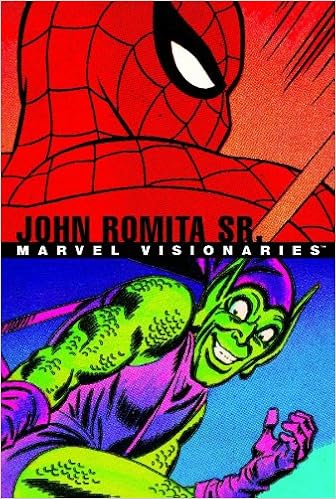
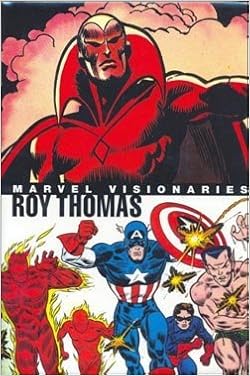
At the August 2007 WizardWorld Chicago comic convention I plunked down some cold, hard cash for three books that have become treasures in my reprint collection: the Marvel Visionaries hardcover volumes for John Buscema, John Romita, Sr., and Roy Thomas.

I am very excited that I bought the Visionaries books. I won't post the exact contents here, but you should know that a simple search on www.amazon.com will reveal that information for you for all of the volumes in the series. You should know, too, that these books are larger than the Masterworks volumes, and at around $35, they cost A LOT less!


Of the three, the John Romita, Sr. book is perhaps the most redundant to my collection. I have the John Romita Sketchbook from Vanguard, as well as a John Romita hardcover published by Marvel several years ago (which I bought firsthand from the Jazzy one at an art gallery when he was in Chicago hyping the giclee that he and Alex Ross did of Spidey vs. the Goblin). Anyway, much of the material in this Visionaries volume was reprinted there, as well as the oft-reprinted ASM 39-40 and 50. Of note, however, is some 1950's Captain America work, as well as some Cap stuff from the late '60's-early '70's. Two issues of his FF run immediately after Kirby left for DC are also in the book; it's funny to see that Romita (or Sinnott) tried to ape Kirby's look rather than let John work his own magic. It’s one of John’s faults – the continual admission that he never felt comfortable penciling, that he always felt he lived in Kirby’s shadow. The reality for me, anyway, is that Romita is one of the most integral creators at Marvel, and gave them their “look” as Nick Cardy helped to give DC their “look” at approximately the same time. At any rate, this is an essential volume because of the nice package and survey of all periods of John's work; but like I stated earlier, there really isn't any surprising material.

Of the remaining two volumes, if I'm ranking, I guess I'd place the Roy Thomas edition second. And that's tough to say -- there are some great stories in it!! What strikes me, however, is what a great survey of Marvel art this volume presents! The work of Gene Colan, Marie Severin, Don Heck, John Buscema, George Klein, Dan Adkins, Mike Esposito, Gil Kane, Tom Palmer, Neal Adams, John Verpoorten, Herb Trimpe, John Severin, Joe Sinnott, Barry Windsor-Smith, Alan Weiss, Dick Giordano, Frank Robbins, Vince Colletta, George Perez, and Jackson Guice is all between the covers, and wonderfully reprinted in fine color (not too bright, as is often my complaint of these retooled volumes – I particularly find the Masterworks series guilty of this. Newsprint was generally muddy – brightening it too much takes away from the original feel). As all books in the series are surveys of the history of a particular artist, this volume showcases the evolution of the company. Essential stories are, of course, Avengers #'s 57-58 and Sub-Mariner #8, which again are often reprinted. The treat in the book for me, though, is Amazing Adventures #8 featuring Neal Adams art on the Inhumans and the Avengers. We just don't see that type of thing in reprint form! Some of Roy's black-and-white work is in here as well, but alas (as is the case in the Buscema volume) no Conan.

Lastly, to no one's surprise (at least no one who has followed this blog or my musings on the Avengers Assemble! message boards) as my favorite, is the John Buscema volume.


The editors made great choices for this -- it truly is the essential John Buscema. And what strikes me most about this book (and to a lesser extent the Romita book) is that what I hold in my hands is truly an evolution of John's work. His late '50's stuff is very rough compared to what we came to know and love in the Silver and Bronze Ages. I think Buscema hit his stride after the examples in the book where he drew over Kirby's lay-outs. I have read in multiple resources that John did not like to have to do that, but when looking at his work in a linear, historical fashion there is no mistaking the King's influence (on Romita, too). Also vital to the Buscema fan is the effect of different inkers on John's pencils. Inkers here include Frank Giacoia, John Tartaglione, Mike Esposito, George Roussos, Sal Buscema, John Romita, Sr., Tom Palmer, Joe Sinnott, John Verpoorten, Syd Shores, Rudy Nebres, Bill Sienkiewicz (my least favorite, bar none), and Stephanie Cerwinski (who is John's granddaughter!). John's first Avengers work (#41-42) is here, as is the pin-up from Annual #2. Later, #'s 75-76 are reprinted, in my mind to pay homage to John's Conan work (Dark Horse currently holds the licensing to Conan and Tarzan properties, and this volume suffers because of it), as that story included Arkon. The treasure in the volume may be Marvel Spotlight #30, with the Warriors Three; Sinnott remarks in his Brush Strokes With Greatness (TwoMorrows) that this was the first time he inked Buscema when John turned in loose breakdowns and Joe had to finish the job. The end result is striking, and it's neat to see Sinnott "do" John Buscema -- there's no mistaking John's presence on the page. One more thing -- Silver Surfer #4 is in here, too, and is in my humble opinion John's standard, his masterpiece. Buscema’s mastery is here – from the almost-splash of Norrin Radd with the animals of Africa to the majesty of Asgard to the brutality of the joust. All comic art should be compared to that single issue. Wow...

Additionally, I’d comment that these volumes contain little text aside from the comic stories. I believe Roy Thomas takes a few pages here and there to comment on the issues included in his volume. He also writes a lengthy introduction to the Buscema volume. A nice touch in the Thomas book is the inclusion of the letters page from FF #176 (where the Impossible Man goes berserk in the Marvel Bullpen) where Roy explains the impetus for that issue. All volumes in the series have dust jackets with additional art and minor commentary; the right side of the jacket has writer/artist profiles. At the conclusions of the Romita, Sr. and Buscema volumes there are some original pencils, watercolors, and character drafts that add a nice touch. However, these types of things only add 3-4 pages to the book and are not to be considered as an expansive sketchbook, et al. Sometimes I think commentary from Stan Lee, Thomas, or other Marvel editors might have been nice to “set the table” for a given story, but that might have perhaps upped the cost and/or dropped the page count for each tome.

At the back of the Buscema volume, there is a four-page story, credited as unpublished but intended for a magazine called "Marvel Italia". The exhibit in the book is a reproduction of John's pencils for the story, which included Loki, Thor, and the Silver Surfer. The pages come courtesy of Sal Velluto, who was the intended inker. I actually have a pencil and ball point pen rough on sketch-paper to page 3 of this story! It is obvious that John sketched it out, liked it, and using a light box reproduced the page onto comic artboard. And there it was, right in the book in my hands! When I first came across this, I made a quick trip to the basement to gather the portfolio in which I keep my non-framed art and viola! My wife was quite impressed...

The Roy Thomas volume contains a very interesting story in regard to inkers, and I guess I’d like to highlight it as one of the many reasons to check out this volume. We've mentioned several times (both here and on the AA! boards) about the power inkers have over pencillers -- Joe Sinnott often being the main subject of those conversations. I would encourage all who are able to view a copy of X-Men #64, the introduction and origin of Sunfire. The issue is credited to Don Heck (filling in for Neal Adams at the time) and Tom Palmer. Palmer is credited as the "embellisher" -- understanding that there can be a difference between inks and embellishing, I would say "did he EVER!"This issue may be the single-most beautiful book ever attributed to Don Heck, and we have Tom Palmer to thank. Given Heck's output at the time (I believe he was on the way out at Marvel and heading to Wonder Woman, et al. at DC), I can honestly say that there are only 3-4 figures in the entire story that one could look at and say, "Yeah, Don Heck's art". Palmer exerts his influence in such a way that this story flows near-seamlessly between the Adams before and after. I truly can't understand why Heck wasn't just credited with lay-outs, thumbnails, whatever -- he's just not in the book.That being said, we've discussed Sinnott and how he "saved" Kirby at times; we could have a similar discussion of Palmer exerting the same type of influence over Buscema's pencils in his last Avengers run (around Under Siege, Acts of Vengeance, etc.) when John was doing very loose lay-outs and Palmer the finishes; it was Palmer who kept the "look" from Buscema to Steve Epting to whoever-came-next. But I'm just surprised that we see this from Palmer so early on in his career.I'm not complaining, don't get me wrong. This is an extremely eye-pleasing story, and Roy Thomas writes a wonderful tale to boot. I just found it interesting given what I'd come to expect from Don Heck in that era how much un-Heck-like the book was.

Other volumes in the series include Stan Lee, two for Jack Kirby, Steve Ditko, Chris Claremont, and John Romita, Jr. Any would make a valuable addition to the library of the Silver and Bronze Age Marvel enthusiast!
Related Posts Plugin for WordPress, Blogger...