Showing posts with label Legion of Super-Heroes. Show all posts

Tuesday, August 11, 2009

More Legion Lore: Teenagers From the Future!

Hi, guys and dolls...hope you're all sipping pina coladas and enjoying the beautiful summer so far. And let's imagine for the rest of said summer, you can buy only two more books about comics—well, it goes without saying one of them has to be Assembled! Volume 2, right? (Available on Amazon...check out our panel to the right for details!)

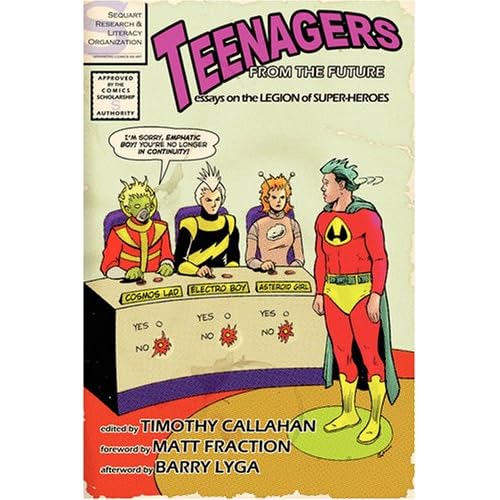
As for the second book, if you’re a Legion of Super-Heroes fan–and who isn’t?—do yourself a huge favor and grab a book called Teenagers From the Future. Like Assembled!, it's an anthology of essays, and also like Assembled! it's a great read: informative, enjoyable, and thought-provoking. I’m not exaggerating when I say that every single essay here is worth reading. You may not agree with the contributors' varied opinions and analyses, but you won't be bored--and you'll come away with an increased knowledge of the Legion's rich history.

Some background: Teenagers From the Future is a collection of essays edited by Timothy Callahan, with a foreword by Matt Fraction. The essays are presented in chronological order according to the Legion’s publishing history, so you get a good overview of the Legion oeuvre: the Silver Age Legion, the progression to the 1970s, 80s, 90s and so on, up through today’s Legion (and yes, the reboots are included).

The topics range from fairly standard (but still interesting) such as the “The Death and Resurrection of Lightning Lad” and “Women in the Early Legion” to the more esoteric “The Legion’s Super-Science” and “Decades to Get It Right: Architecture and Utopia” to the provocative “Diversity an Evolution in the Reboot Legion” and “The Racial Politics in the Legion” to…well, you get the idea. And what Legion tome would be complete without a piece on the Legion’s splendiferous sartorial style—so we get “Fashions From the Future, or ‘I Swear, Computo Forced Me to Wear This!’ "

There's commentary on the usual suspects including Mort Weisinger, Jim Shooter, Paul Levitz, and Mark Waid…but there’s also attention paid to the Legion’s earliest scripters Edmond Hamilton and Jerry Siegel. A minor quibble: I would have liked to seen an essay focusing on E. Nelson Bridwell (hey, Timothy Callahan, if you’re reading this and need an extra essay or two for your next volume…)

The book includes a fair number of reproduced panels and covers throughout (in black and white, alas) and there's a handful of factual errors, but it’s a very captivating read and provides a good basic overview of those kids from the future. If your local comic shop doesn't carry Teenagers, head on over to ever-reliable Amazon and order a copy. Happy reading!

Sunday, July 12, 2009

You've Lost That Loving Feeling...

It's tough these days for a fan of the Silver/Bronze Age. Contemporary comics, while they may be prettier to look at -- the art is certainly more complex, and the color palette available boggles the mind -- don't have the overall substance that those stories of yore brought to the reader each month. While there are a few modern books I enjoy, I often find that it is those stories with sort of an "old school" feel that make me smile -- and for the prices the publishers want these days, it would take a little effort to smile! Current trends of decompressed storytelling, anatomically incorrect art, and meandering plots just leave me cold. So, what I'd like to do here is spend a few minutes recommending some books from the past 15-18 years that can bring you back to those good times.


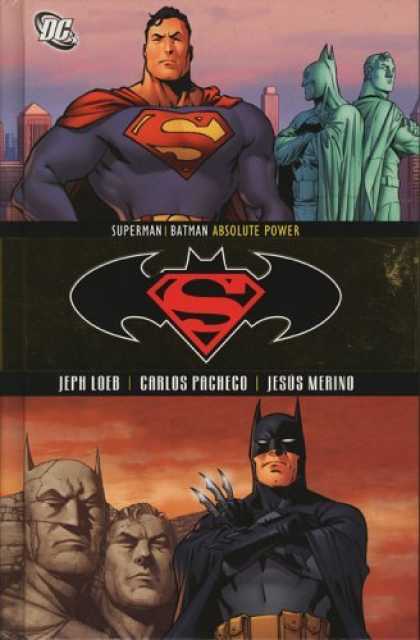
Superman/Batman: Absolute Power. Jeph Loeb, Carlos Pacheco, and Jesus Merino

Reprinting Superman/Batman #14-18. Published 2005 and MSRP $12.99


A lot of people knock Jeph Loeb, and I would never say that modern knocking of him isn't justified -- one need only look upon the trainwreck that was Marvel's Ultimates, Volume III to see what this man wrought on Earth's Mightiest Heroes. Yuck! However, I have largely enjoyed much of his writing on Superman/Batman and this volume is perhaps my favorite in the series of trade paperbacks. It certainly doesn't hurt that the art by Carlos Pacheco is every bit as good as his masterpiece that was Avengers Forever. The back cover tells the gist of the story:


"The Earth wakes up one day to a brand-new world order -- one in which Superman and Batman rule with an iron fist. Humankind has a choice: obey or die. How did things get this way? And is anyone left who can stop them?"

Loeb pens a really fun tale. It's what back in the day would have been called an "imaginary story"; perhaps in the language of today it's an Elseworlds story. The synopsis above is the thread that runs through most of the book, but what a tour de force of DC history this book is! From the Legion of Super-Villains to Uncle Sam and the Freedom Fighters, from the Mike Grell-era Legion to Kamandi, from Sgt. Rock to the Haunted Tank and then on to the Adult Legion, Loeb romps through the 1970's in a really fun, fast-paced story. I highly recommend this as a wonderful nostalgia trip!


The Adventures of Captain America: Sentinel of Liberty. Fabien Nicieza, Kevin Maguire, Kevin West, Steve Carr, Terry Austin.


Four-issue prestige-format series, published in 1991-92; has not been collected in tpb format.

Can anyone out there tell me, with all of the CRAP that gets collected into a trade paperback, why this story still languishes in four prestige issues?? This book is wonderful!! I can't recall very many times in the past 20 years when I have enjoyed a book this much. First of all, I love Kevin Maguire's art -- I have since the Justice League's post-Crisis days. And Maguire's style fits Fabian Nicieza's story to a T. However, Maguire moves to "storyteller" credit in issues 3 and 4 as Kevin West and Steve Carr take over the penciling. Inks throughout are by Terry Austin, who gives the book a consistent look. Much of the appearance that modern readers would associate with today's Ultimate Captain America is here -- the pronounced chain mail and the helmet most notably.


If you are at all familiar with the serialized movie adventures of 1940's action heroes like Flash Gordon, you'll really take to this tale. Each book ends with a cliffhanger, and all of the intrigue of WWII, Hitler, and of course the Red Skull are here. Great stuff, and I'd imagine that through either the back issue bin or eBay, you won't have to pay much over the $5 cover price. Check it out!!


JLA: Liberty and Justice. Paul Dini and Alex Ross.

One-Shot, Treasury-sized. DC Comics, November 2003. MSRP $9.95 at the time of publication.


The dedication of this volume, one of many books in the Paul Dini/Alex Ross collaborations that began with Superman: Peace on Earth, is to 1970's Justice League of America artist Dick Dillin. This couldn't be more appropriate, as Dini and Ross weave a tale of the JLA of that era. This is a younger JLA; Aquaman has both hands, Barry Allen is the Flash, and there is no gray on Hal Jordan's temples. As such, it's a JLA bereft of some of the post-Crisis baggage and it is better for it. This story follows the original seven, but includes enough cameos and guest appearances to satisfy any fan of Bronze Age DC Comics. The basics of the story are found on the book's back cover:


"In JLA: Liberty and Justice, the League confronts a threat from space, but a much different menace from those they have faced before. This new danger arrives on our planet in the form of an alien disease -- a cellular composition unlike anything on Earth, deadly to all who come in contact with it. The virus spreads quickly, setting off a chain reaction of global fear and panic. Soon the Justice League themselves are under suspicion -- are they ultimately responsible for this alien danger? Before long, paranoia, distrust, and an ensuing wave of hysteria threaten to rip the world apart."

Great stuff --fast-paced writing, and Alex Ross' art is never hard on the eye. Appearances by Green Arrow, Hawkman, the Atom, Black Canary, and Plastic Man (among other cameos) really make this a fun read!


Tuesday, April 28, 2009

Time Keeps On Slipping: The Adult Legion


Adventure 355 Legion of Super-Villains
Adventure #355 (1967)

Adventure Comics 355 (April 1967)
“The War of the Legions!”
Jim Shooter, Curt Swan/George Klein

Doug: Here we are for part two of our look at the Adult Legion – this story is somewhat of a conclusion to the tale we looked at last week, although it could be considered a done-in-one.


Doug: DC had a habit in the Silver Age that I guess strikes me as similar to Marvel’s use these days of the first page of the book as a non-story page. Nowadays Marvel gives the reader a recap of past issues; DC, over 40 years ago, gave the reader (to me) a second cover – that is, they printed an image that was a teaser of what was to come in the following pages. In either instance, I really feel the readers are cheated out of additional story/art space. But I’ll give a slight tip of the hat to DC in that the reader at least got a large splash page instead of a small recycled panel (as Marvel does).

Karen: Since I only started reading DC in the mid 70s, I haven’t seen too many of these splash pages. It seems very odd to a Marvel reader like me. With a lot of the old Marvel books, they liked to start in media res! But DC’s method here is preferable to the text recap pages used now.

Sharon: That was part of the DC formula—the splash page functioned as a second cover—just in case the cover by itself was not enough to reel in the impressionable youngster! And of course, Superman (or Superboy), being the main DC attraction, had to be featured on the cover-- even if, as here, he’s only in a few panels in the story.

Doug: Time travel problem (again!) – on the second page, Superman comments to the assembled Legionnaires that he must return to his own time to get some pressing work done. Why couldn’t Brainy just send him back to the exact second he had left? No one would have known he was gone, and whatever deadlines he had wouldn’t be in danger. Ah, well…

Karen: Time travel is always messy. That’s why it’s so disturbing when Brainy says time travel is commonplace! How many things would get screwed up if people were time travelling willy-nilly all over the place –er, time?

Sharon: Yeah, some readers would write in and question why Superman (or Superboy) was in the future for, say, two weeks, did that necessarily mean he was gone from the 20th century for those two weeks? Why wouldn’t he return to his own time a few seconds after he left? Some readers—including kids--didn’t buy it.

Karen: Also, Superman’s quote at hearing about the casualness of time travel – “Well I’ll be a three-eyed Kryptonian babootch!” – just kills me! Was he always saying stuff like that back in the 60s, or was that just Shooter?

Sharon: The dialogue was consistent with how Superman was usually written in his own comic and throughout the Weisinger-edited books. We tend to credit Stan Lee with creating a unified Marvel Universe but overlook the fact that some editors at DC were doing the same thing—the difference is, at DC the editors (Weisinger, Schwartz, et al) each oversaw 4-8 books, and not an entire line comprised of 8-10 titles (as Stan did). While there were varying degrees of character/story consistency among each DC editors’ set of books, Weisinger really stands out as someone who championed a cohesive mythology for his books (Superman, Superboy, Superman and Supergirl in Action, Superboy and the Legion in Adventure, World’s Finest, Jimmy Olsen, Lois Lane) by mixing and matching the same elements among them: the LSH, Supergirl, Jimmy, Lois, Perry White, Lana Lang, Lucy Lane, Lori Lemaris and Atlantis, Pete Ross, the super pets, Ma and Pa Kent, Kryptonite, Kandor, Argo City, the Fortress of Solitude, the Phantom Zone, Bizarro, Braniac, Luthor, Lena Thorul, etc.

Sharon: It’s no accident that as his Superman family was growing, Weisinger also instituted the first DC Annual, which compiled earlier tales of Superman (the start of the fabled 80-page DC Giants), so that his audience could familiarize themselves with Superman’s history. Weisinger had already woven a rich Superman tapestry before the Fantastic Four were a gleam in Stan or Jack’s eyes (well, maybe not Jack’s because the FF is reminiscent of Jack’s Challengers of the Unknown. But that’s a topic for another day…). Anyway, while Stan and Jack and Marvel can be credited with tapping into a new, older audience, kudos should also be given to Weisinger, who sought to provide his (younger) audience with an interconnected cast of characters and concepts.

Doug: “That weird ship hovering up there… as if waiting for something???” said Brainiac-5, the smartest guy around. Hey, dude, the SV logo on it ring a bell? Duh – not until the next panel when he gets himself captured.

Sharon: Maybe he thought the vessel belonged to Shrinking Violet? Oh, that’s right, she had retired…

Doug: And if you’re the Legion of Super-Villains, why don’t you just announce your presence?? This is really a quaint way of storytelling – the innocence in it is lost in today’s mags filled with sex and ultra-violence.

Doug: I also liked the SV seal on the envelopes that popped into the Legion’s hands – reminded me of the Hallmark Gold Crown stickers!

Doug: So anyway, Superman leaves, Brainy is kidnapped, and the five Legionnaires in this story (Lightning Man, Cosmic Man, Saturn Woman, Polar Man, and Element Man) are sent to five different destinations to try to find him. Two new do-badders are introduced for this tale – Echo, the master of sound, and Beauty Blaze, who can manipulate fire.

Sharon: You know, even with the additional two members, I find it amusing that a grand total of five baddies constitutes a “legion!” I guess we’re meant to assume there are plenty of other criminal members of the LSV, but they just weren’t available for this mission?


Doug: Interestingly enough, Lightning Lord and Saturn Queen combat their younger counterparts, but Cosmic King does battle with Element Man while Cosmic Man battles Echo.

Sharon: Element Man and Cosmic King’s similar powers made them natural adversaries, as far back in Adventure #331 when the teen Element Lad’s powers were used to counteract Cosmic King’s.

Karen: Wasn’t splitting the team up a typical DC convention of the time? I seem to recall this often occurred in Justice League.

Sharon: Yes, and it often happened to the Legion too, when they opposed a team--the Fatal Five, the Wanderers…


Doug: Shooter must have done his homework, or perhaps he was a closet alchemist – Element Man informs us that Cosmic King’s plot to destroy Metropolis by exploding plutonium was stifled when EM transmuted nearby objects to cadmium, which absorbs plutonium neutrons thus preventing the explosion. Hey, who am I to say?? Seems plausible to me!

Karen: Shooter tried to give scientific explanations for most of the Legionnaires’ feats here. He must have been paying attention in his science classes!

Sharon: I love how Saturn Woman’s evil nature is underscored by her thin, “unattractive” (for a comic book female) face. And does anyone else think Echo’s face looks a wee bit like the similarly powered Klaw (who’d been introduced in the Fantastic Four comic about a year earlier)?


Doug: Well, to make a long story short, the Legion gets their collective butts kicked by the cadre of super-villains, only to be saved at the last minute by… Let me just say that I didn’t care for the ending. In my opinion, doing the obvious trick of having Superman/-boy suddenly reappear, or Mon-el, or whoever, would have been better than the choice Shooter (certainly under the orders of Mort Weisinger) made.

Karen: I agree, this was a very weak ending. It was probably supposed to shock the reader but it just seemed so contrived. Then again, it was written by a teen-ager, for a young audience. However, the previous ‘Adult Legion’ story did have its charms. This one just comes up flat.

Sharon: I’m going to have to “spoil” this 40-year-old story, so if anyone has not read #355 and wants to be surprised, read no further. The ending illustrates the downside to Weisinger’s cohesive approach to the Superman titles; there was a tendency to overuse the common elements. For one thing, in #355 the two saviors show up in lead lined armors—just as Sir Prize and Miss Terious did a scant few issues earlier, in Adventure #350 and #351! I’ve heard of recycling plots but—a scant 4 issues later?? Then, three months later after Mr. Mxyzptlk’s appearance in #355, he shows up again in the “surprise” ending in World’s Finest #169 (despite the presence of Batman, World’s Finest was very much a typical Superman book edited by Weisinger).

Sharon: All in all, I agree with my esteemed colleagues that #355’s story was not as entertaining as #354’s. However, both issues provide a good look at quintessential DC back then: “once and done” tales that were complete in themselves (even with the occasional two-parter as here)--short stories, as opposed to Marvel’s ongoing “novels.” Any real changes to the tried-and-true DC formula were about a year away (1968), when DC finally had to admit that Marvel was no mere flash in the pan.

Tuesday, April 21, 2009

Tomorrow Never Knows: The Adult Legion


Adventure 354 Curt Swan
Adventure #354 (1967) 
Adventure Comics # 354 (March 1967)
“The Adult Legion!"
Jim Shooter, Curt Swan/George Klein

Doug: This week it’s back to the Silver Age! It’s been a few months since we’ve discussed the 1960’s, and actually quite a long time since we’ve done anything DC. We’ll rectify both of those situations with this installment’s look at a fun chapter in the annals of the Legion of Super-Heroes – the Adult Legion! Unless otherwise stated, we are all using the trade paperback, Legion of Super-Heroes: 1,050 Years of the Future.

Sharon: While I own the great trade paperback Doug mentions, I also have a copy of the comic itself in my hot little hands, purchased a couple of years ago—the comic, that is, not my hands. I’ll be looking at both the reprint in the book and the comic.

Doug: The first thing I noticed on the splash page of Adventure 354 was that the Legionnaires were all still wearing the same costumes they’d worn as teenagers. Lord have mercy, but if I was still wearing all of those floral polyester shirts… I also noticed that Cosmic Boy had a receding hairline, a condition that would afflict other teammates as well. Isn’t it funny that while writers and artists let their imaginations run wild with rocket ships, futuristic buildings, etc., they couldn’t seem to grasp medical advancements?

Sharon: May I ask why, in the Legion’s headquarters, there is an exhibit commemorating the marriages in the Legion? Other than functioning as exposition, of course.

Karen: The depictions of the ‘adult’ Legionnaires are pretty funny. The men all look significantly older than Superman – or how most of the DC heroes were portrayed. I know they wanted to alter their appearances enough so that the (presumably) young reader would understand that these were grown-ups, but they look like they are closing in on retirement! Especially surprising was the former Colossal Boy, who sports a full beard! I don’t think I’ve seen many bearded characters in comics from that time (the Chief from the Doom Patrol is the only one I can think of off-hand).


Sharon: The visual depiction of the adult male Legionnaires was hilarious: they are all follicularly challenged and most sport at least a hint of jowls/double chin, whereas Supes is his usual handsome self. Are we to assume that having Kryptonian genes-- and not exercise and healthy eating-- is the key to aging gracefully?

Karen: It’s also very indicative of the times, that the male Legionnaires who have left the Legion are shown as having careers – Matter Eater Lad is president of his homeworld, Mon-El is a space explorer, Ultra Boy is director of the Science Police – but the female ex-Legionnaires all seem to be wives and mothers!

Sharon: Except for the ever-independent Saturn Girl—I mean, Saturn Woman. Sure, she’s married here, but she’s not about to relinquish her Legion duties! The fact that the rest of the women are all stay-at-home moms is unimaginative and disappointing for a series that is based in the far-off future. Scripter Jim Shooter was 15 or so at the time, and he's mentioned in interviews that he was instructed by E. Nelson Bridwell (who was in his mid-thirties) regarding how the adult Legionnaires should be written and who was married to  whom; I wish both had demonstrated more imagination regarding the female Legionnaires. 

Doug: The art in this story is just vintage Curt Swan. I know Sharon will want to comment on the able inks of George Klein. Swan’s Superman is thick and barrel-chested with that classic Superman chin and spit curl. While DC’s Silver Age artists often lacked the realism of Marvel’s John Buscema and John Romita, they did offer up a look as distinctive to their characters as Jack Kirby’s style was for Marvel’s stable. I often find that Swan’s et al.’s more “cartoony” style seemed to fit with the stories DC’s writers were telling – generally one-and-done tales with a mystery or moral twist.

Karen: Even though I haven't read many Superman titles, I think the Curt Swan look is probably the one that pops into my head when I first think of Superman. It’s iconic, very simple yet strong.

Sharon: Swan-Klein will always represent the classic Silver Age DC look for me even if it’s static (especially when compared to the dynamic style at Marvel during this time)…but the static look kind of suits the classic aura of Superman and the Superman family. George Klein’s embellishments perfectly, subtly enhanced Swan’s clean lines; there was no distortion. Later on, when Jack Abel inked Swan’s Superman and Legion, the artwork had a completely different, and less pleasing, look.

Doug: As far as the story goes, Superman is summoned to the future, but a few years later than when he usually visited. I thought this created a great deal of questions – for instance, whenever the teen Legion needed a bit more power, why didn’t they contact Superman rather than Superboy? Interesting…

Sharon: Right. Talk about opening a can of worms. The idea that Superboy only visits the teen Legion and Superman visits the adult Legion is silly; but it probably had to be reduced to this simple a level because of the readership at the time, and also because of the young author writing it.


Doug: Anyway, the technology is again interesting. In an era when time travel and teleportation seem commonplace, why the need for the monorail trains?

Sharon: Also how ridiculous is it that Superman immediately lapsed into calling the heroes by their “adult” names: Night Woman, Cosmic Man, etc.

Doug: Did Brainiac 5 strike anyone as doing a Ward Cleaver impression? That he showed up smoking a pipe was just priceless! It really mimicked the entertainment of the ‘60’s, when smoking on television and in film was quite en vogue.
Karen: Another sign of the times. Of course, anyone as smart as Brainy should’ve known better than to be smoking! But I am sure in the 30th century, they all smoke vitamins or some other wonderful substance!

Sharon: Again, hilarious. And let’s not forget that Shooter was laying out these Legion stories for veteran penciler Swan; so the pipe came from Shooter’s rough pencils. I guess to a young teen back then, a pipe was an appropriate prop for a thinking man such as Brainy.

Doug: Anyway, the Legion is being attacked from someone who knows all of their secrets, despite the fact that there have been many recent changes to their headquarters, etc. Thus begins a typical DC Silver Age mystery story. I must admit, I had this one figured out right from the start – most authors didn’t include enough clues (or I’m just dense) that the reader could figure out the ending too easily. Jim Shooter tipped his hand early in this one, revealing the identity of the miscreant on page 15 of the story.

Karen: Yup, the mystery villain of this story is fairly obvious. The real pleasure in the tale is seeing the Legion’s future. Besides Superman’s view screen chats with former Legionnaires, we see the statues in the Legion’s HQ which give us clues to the fate of many characters – and I believe foreshadowed the arrival of some, such as Shadow Lass.

Sharon: Right, although the fact that Shady’s memorial statue’s skin was flesh-colored (Caucasian) here caused a flurry of letters later on, after she was introduced as a blue-skinned beauty. I believe Weisinger explained the statue’s hue was a simple coloring mistake, though later on someone theorized that her memorial statue was Earth flesh-colored because that’s how she appeared when Mon-El first fell in love with her (when she was masquerading as an Earth girl in Adventure #369-370).

Sharon: Speaking of the memorial statues of fallen Legionnaires, besides Shady we see Ferro Lad’s statue. Ferro Lad had just been killed off in the previous issue (#353), so Shooter’s future Legion tale was a bit of a respite from the tragedy that that just occurred, as well as a way to underscore that Ferro Lad would indeed stay dead (a rarity in comics).

Sharon: But at least one young reader was more intrigued by two statues that weren’t as prominent as Ferro Lad or Shady’s. So enchanted was this reader by the Chemical King and Quantum Queen statues that appeared on the cover--by their complementary “royal” names, by their coloring (Chem: green costume with black hair, Q. Queen: pink costume with white hair), by their inescapable, tragic fates--that a few years later, when Chemical King officially joined the Legion, she wrote a letter to the editor proposing these two doomed heroes get married, thus making their fates even more tragic. The letter was published, though a romance never materialized. But such was the appeal of the Legion; its young fans really got involved with the characters/stories/possibilities. (And forty years later I still think Chem and Queeny should have hooked up!)

Doug: I enjoyed “visiting” all of the grown-up Legionnaires. I especially liked seeing Mon-el in action. Mon has always been my favorite Legionnaire – he has all of the powers of Superboy without the baggage of the Silver Age Superman and all of his silly villains and stories. I also think he has one of the truly classic superhero suits in all of comicdom. Another fine touch was the presence of Polar Boy as an active member of the team. I loved the tales when the Substitute Heroes would attempt to save the day. I really enjoyed the mid-80’s Cosmic Boy mini-series that detailed his relationship with Night Girl. Good stuff.

Sharon: The problem with this story is that Shooter painted himself into a corner. We knew from years-earlier Supergirl story that Lighting Lad and Saturn Girl would eventually wed, but now we knew about the rest of the Legion regarding who would marry whom; and also who would remain alive until at least adulthood. True, we had just seen Ferro Lad die in action; and in the adult story newer members Karate Kid and Princess Projectra weren’t shown, and neither were veterans Chameleon Boy, Sun Boy or Invisible Kid (which was convenient later on as the Kid was killed in action some years later), but based on this story--which was taken as canon at the time-- we knew almost everyone else would make it past puberty unscathed, none the worse for the wear except for some extra pounds and less hair.

Doug: I love the signs hanging everywhere that identify the doors, buildings, etc. Can you see the influence of the Batman television series in Shooter’s writing?

Karen: Hilarious – big signs everywhere! I especially like the building with the sign “Arsenal” over it. Sure, just let everyone know where all the weapons are!
Sharon: Appropriate that you should mention the Batman TV show, Doug. According to many Shooter interviews, Weisinger instructed Shooter to watch Batman. Then Weisinger would call Shooter (at the Shooter family home in Pittsburgh) and quiz him on the episode, to see what the kid had picked up from the show. (And it’s well-known he also encouraged Shooter—and his other writers—to look to classic novels, short stories and movies for inspiration.)

Doug: The story plays out with a battle royale between the perpetrator and the team, and the big reveal was rewarding for me, as I said earlier I’d sleuthed the ending (very uncommon for me – DC was truly writing for my childlike mind!). But the biggest pay-off comes in the last three panels, when it is unveiled that the true masterminds of this heinous plot are none other than the Legion of Super-Villains!! Stay tuned!

Saturday, August 30, 2008

1st Appearance: The Legion of Super-Heroes (Adventure Comics # 247, April 1958)


Adventure Comics 247 Legion
Adventure #247 (1958) Three strikes and you're out, Superboy!

Doug: As the Legion of Super-Heroes celebrates 50 years in print (albeit in many different versions), I’d like to reflect briefly on my relationship to the team over the past four decades. The first issue I can recall owning was Superboy and the Legion of Super-Heroes #210, circa 1973. That means the team was only 15 years old when I stumbled upon them. As a youngster I was very much drawn to the “kid” characters; sure I liked the “adult” comics like the Avengers, the Fantastic Four, Spider-Man, Batman, etc. But I had a fascination with the Teen Titans, the Legion, Marvel’s Nova, and Kid Flash flying “solo” in the Secret Society of Super-Villains. These were just school aged kids like me. Despite the tremendous feats that they could perform, I somehow found it easier to relate to them and looked forward to each and every adventure I could grab at the local newsstand.

But for some reason I just could never get into Superman comics. I guess he was too powerful for my tastes. Having begun to experience Marvel and all of their heroes’ Achilles heels and personality flaws, Superman was to me too perfect, and the different colors of Kryptonite were too silly. But Superboy… Superboy was different. He was a kid like me, and boy – were his friends cool! And, how about those costumes?? Even as an 8-year old there was a sexiness to the Legion. I didn’t know of Dave Cockrum at the time, as Mike Grell was “my” Legion artist. But I think those of us who grew up in the 1970’s are forever in Cockrum’s debt for those far-out and groovy costumes he designed! Who can forget Phantom Girl’s pigtails and bellbottoms? How about Saturn Girl’s swimsuit, or Cosmic Boy’s gravity-defying “cover-up”? Great (although certainly dated!!) stuff…

I recall the first time I saw the Legion in their classic outfits. At a flea market I had come across the reprint series “Legion of Super-Heroes”, which re-presented several classic tales in four issues. I thought – “Ugh… how primitive. These costumes are nothing like what we have today!” But I was intrigued, now fully aware that there was quite a backstory to the team. I began to search for older issues of Superboy and Adventure Comics. The large Limited Collector’s Edition #C-49 (reprinting Adventure Comics #’s 369-370) was and still is a treasure to me. Incidentally, the cover to that LCE doubles as the cover art to the recently-released Legion of Super-Heroes: 1,050 Years of the Future trade paperback. The Legion was taking on a new life due to my discovery of its rich history.

Karen: I started reading Legion around the same time as Doug; the first issue I can recall was Superboy 195, with Wildfire (or ERG-1, as he was originally called). To me the Legion was appealing for a few reasons. One was the teenager angle; another was the outer space adventure; and finally, it was ‘forbidden fruit’, as my family was staunch Marvel fans. So I actually kept my Legion books a secret for a little while!

But Legion was the title that introduced me to the DC Universe, and made me realize that DC wasn’t so bad; in fact, they had a lot of good books! It opened up yet another comic universe for me. Despite all the iterations (mostly needless, in my opinion) the Legion has gone through, I still have a special fondness for the team.

Sharon: I have always loved the Legion. After I discovered Marvel and its far superior comics, I basically stopped reading DC comics—except for the Legion in Adventure (and later, Action). And if you’ll permit me to boast a bit, I even had a couple of letters published in Adventure.

Karen: Wow, Sharon, that’s very cool! Do you recall the issue numbers? My Adventure collection is limited, but I’d love to see those letters.

Doug: Let’s discuss the very beginning of the Legion, in Adventure Comics #247. I really don’t recall when I first read this story; I’m sure it was in the pages of one of DC’s reprint giants during the latter 1970’s. For this discussion, I’ve used both the aforementioned Legion of Super-Heroes: 1,050 Years of the Future tpb and the Legion Archives, Volume I. I did the cross-reference primarily for coloring comparisons – I’ll make reference to this later.

To begin, I much prefer the cover depiction of the Legionnaires to the interior. I am speaking specifically of the names on the front of the youths’ costumes. That seems really silly to me, for someone to run around with their name stitched on the front of their clothing. In addition, while Al Plastino’s interiors are fine and certainly indicative of the pencils of the day, for my money you just can’t beat Curt Swan!! I just felt there was a truly youthful air about the faces on the cover. The Legion kids really did look like they were in that 12-13 year-old age range. Maybe that’s too young, but the cover gives that impression. Also of note at the beginning of this tale is DC’s Silver Age policy of a splash page that isn’t really a story page, but serves almost as a “second cover” – another grab for the potential buyer. However, while it might be true that not every cover actually contained elements of the story within, these splash pages always did.

Karen: Ugh, yes the names on the costumes are just so dorky. I think it’s another sign that the books definitely were aimed at a much younger audience. I agree about Curt Swan’s art: it looks very simple and unadorned now, but it has a classic feel to it (and I love how his Superman looks big!)

Sharon: Surprisingly, the original costumes do have the classic “chevrons”- -but having the names displayed on their chests is too much, as both of you have stated. Not to mention the placards describing their powers (“super thought-casting”). Well, as you mentioned, since the target audience was kids, I guess everything had to be spelled out—literally.

The costumes’ coloring is jarring. Okay, Cos has his familiar pale pink (at least for his shirt), but Saturn Girl and Lightning Lad—excuse me, Lightning Boy—just look so strange. With the red and yellow costume, Garth looks like Sun Boy!

As for the art, Curt was the man. He gave a very classic look to the Legion, especially when inked by George Klein. When I think of the Legion, I think of them as depicted by the Swan-Klein team. Klein was also the definitive John Buscema inker, IMO.

Doug: As to the story itself: it’s so dated now, so stuck in the 1950’s… but I just love it! It’s cute, quaint, and dare I say – wholesome? So unlike what is on the stands today. But, while I would not presume to say that this story would sell were it issued now, I would say that its elements of feel-good, happy ending, and a little mystery easily solved would be a welcome respite from today’s anti-heroes and blurred morality. But I digress…

Specifically in regard to the 1950’s elements: the Legion’s time bubble is interesting in comparison to other means of time travel in the comics, notably Marvel’s Dr. Doom time platform. Both are means to an end, but an interesting visual contrast nonetheless. I also liked the scene at the soda fountain, the lecture hall (didn’t they have any sense that one day students would learn from podcasts?? Ha!), and the tongue-in-cheek reference to Jules Verne’s “Around the World in 80 Minutes” – things that original buyers of this comic could certainly relate to.

Sharon: Without a doubt the story (like much of DC at the time) is geared toward a very young audience (and one that would “recycle” after five years as kids outgrew comics). The notion of belonging to a “club” is very appealing to kids. And the dialogue is ultra-expository, to ensure the story is clear enough for young readers (“when I clap my hands, I produce lightning!”)

Karen: I really have to remind myself of the year (1958) and the audience that this book was aimed at, because it’s a pretty simplistic, even nonsensical story. For the benefit of folks who have never read it, let me recap: Saturn Girl, Cosmic Boy, and Lightning Boy (not Lad yet) come to Smallville and invite Superboy to try out for their super-hero club. They compete in tests against him and all three beat the boy of steel. The poor kid is nearly in tears (!) when they reveal it was all a test to see how he’d handle defeat – I guess, they really just say it was an initiation test! I’m not sure what message they were trying to get across to kids – treat your friends like crap and then later tell them it was all a test? It’s not the most likeable presentation of these new characters.

Sharon: Superboy sure is super-sensitive. His whining, his shame (“How will I ever tell them in Smallville I flunked the Super-Hero club?”), his tears—give me a break!

Karen: well, that’s no surprise; it seems like over the last few years I see Superman crying on almost every cover!

Doug: The main body of the first Legion story is somewhat typical DC formulaic storytelling. If anyone has had the opportunity to read the Legion’s second appearance from Adventure Comics #267, it has a similar plot device. Superboy (and other DC characters of this era) is just used and abused. I guess it was the only way the authors could figure to have their heroes seem as less than gods – to just be mean to them!

I mentioned above that I referred to a second version of this story, in order to compare the coloring. On page 11 of the story, after Superboy has been accepted to the ranks of the “Super-Hero Club” – nowhere within the story are they referred to as the Legion, something I found very odd – there are other kids present in the room. The young green fellow (and yes, he’s green in any version I can get hold of) can be no one other than Brainiac-5, and it certainly looks as though Mon-el is standing behind him. While it would be some time before these characters would be introduced as we know them, this was a nice bit of historical continuity for me to discover. I only wonder if later creators were aware of this.

Sharon: The kid certainly looks like Brainy: blond hair, pale green skin, and even the purple utilitarian costume! (I am basing this on the version that appears in the Legion of Super-Heroes: 1,050 Years of the Future trade paperback Doug mentioned.)

Karen: Since Mon-El didn’t appear until 1961, I think that may just be a case of coincidence, or maybe the colorists on the reprints were having fun. I’d assume the same with the Brainiac 5 (it’s taxing my memory, but wasn’t he the tenth recruit or so?).

Sharon: As far as I know, Brainy joined the Legion in a Supergirl story that is just as simplistic as this one. Check out Action Comics #276, cover date May 1961, “Supergirl’s Three Super Girl-Friends.” For the record, the gal pals are Saturn Girl, Phantom Girl, and Triplicate Girl. Supergirl is bemoaning her lack of friends (male and female) until the Legion trio shows up. They invite her to reapply for membership (she’d been rejected before—don’t ask why—but if you’re really curious, see Action #267, August 1960). Anyway, she meets Brainiac 5 and thinks he looks an awful lot like—gasp!—Brainiac (why, just because of the green skin??). Brainiac 5 proves he’s nothing like the evil 20th century villain and he wins her heart. Brainy and Supergirl are both inducted into the Legion and he asks her to stay in the 30th century and “be my girl.”

But there’s more! She returns to the 20th century and runs into Jerro the mer-boy. So at the story’s end, Supergirl is now super-happy because not only does she have three new girlfriends, she also has not one but two boyfriends—though of course as Linda Lee, the poor girl can’t tell anyone! (Incidentally, this “classic” was written by Jerry Siegel.)

Boy, in these stories there seems to be awful lot of emphasis placed on being popular…


Doug: I read a discussion on a message board not too long ago concerning whether or not first appearances should be required to be origin stories. While the Overstreet Comic Book Price Guide lists this book as both the first appearance and origin, it certainly isn’t the origin we know. Where’s RJ Brande? Nowhere in these pages. Really, all Cosmic Boy says is that they are a club with members who each have a different power. So, for the purposes of introducing these characters (which I understand were considered throwaways), I guess that mission was accomplished. How they got together would be a story for many days… in the future!

Karen: Yes, it’s interesting just how much of a non-origin story this first appearance is. Since it revolves around Superboy, they probably didn’t feel the need to explain the hows or whys of the kids getting together. It doesn’t seem like they planned to ever bring them back; I believe it was all due to positive reader response. Sharon, do you have any info on that?

Sharon: You’re right, Karen, the Legion proved to be popular with readers (kids) so the team made repeat appearances (Superboy, the Superboy feature in Adventure, the Supergirl feature in Action) until it was given its own series. Editor Mort Weisinger did try to create a “Superman Universe” and mythos…he liked having a stable of core characters and concepts throughout his books (Superman, Superboy, Adventure, Action, Lois Lane, Jimmy Olsen, etc.). So when a character or concept sparked some interest (spikes in sales, or letter feedback), he would run with it.

The Legion didn’t get a proper origin story until ten years after their 1958 debut, in Superboy #147 (which was an 80-page Giant, devoted to the Legion, cover date June 1968). In addition to reprint material, this issue contained new material, a story about how the founders—Cosmic Boy, Lightning Lad, and Saturn Girl—met R.J. Brande and how the Legion was formed. The talented (and IMO, underrated) E. Nelson Bridwell wrote the story.
Related Posts Plugin for WordPress, Blogger...