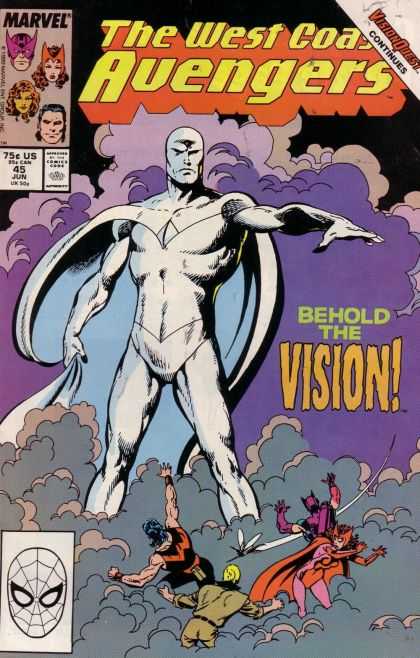
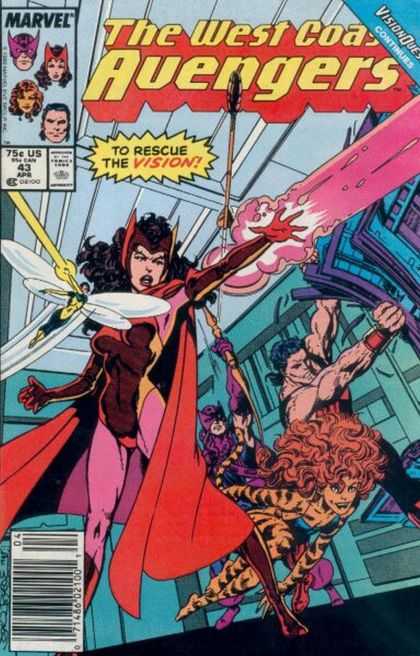
West Coast Avengers # 45 (June 1989)
“New Faces”
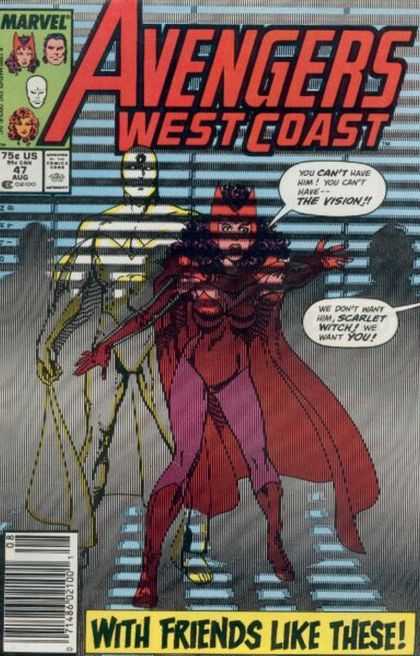
Avengers West Coast #47 (August 1989)
“With Friends Like These!”
Writer/Penciler: John Byrne
Sharon: Continuing with the flashbacks in AWC #45: we see the Vision’s creation at the hands of Ultron, and Avengers #152 (Wonder Man’s resurrection). I know it’s revealed a couple of issues later that Simon is in love with Wanda, but why would he object to helping his long-time friends, Wanda and Vision? Did he really think that not helping Wanda would make her love him (Simon) instead of the Vision?
Karen: It’s certainly an unflattering view of Wonder Man, at the least. And as you say, it appears contradictory to what we’ve seen of Simon in the past. By this time, his relationship with the Vision was fairly well-established – they looked on one another as almost brothers. For him to deny his “brother” a soul – primarily because he was interested in his “sister-in-law” – is pretty low.
 Doug: Simon does come as very wishy-washy. Byrne did a nice job of portraying Simon as a milksop with the pose he drew him in for panel 2 on page 20. Jeez, Wondy looks like he’s ready for “Beach Blanket Bingo”!!
Sharon: The grief-stricken Wanda uses her power to bring down an entire cliff on Simon. He’s invulnerable, of course, but the intent was clear. As in the last issue, Wanda uses her power in an extremely destructive manner and once again I really felt the ferocity of her anger here.
 Karen: Wanda certainly has improved from the days when her best shot was making villains trip!
Sharon: It’s in keeping with the nature of her powers, at least as I have always seen them: she causes “accidents” to happen: guns explode; people trip themselves up, buildings crumble, etc. An emotional person like Wanda having this type of unpredictable power is almost like a curse and it’s part of the character’s perpetual air of tragedy—makes her a great character, IMO. And I much prefer this sort of power for Wanda rather than her learning sorcery and spells and becoming like the Enchantress or Miss Harkness. By the way, it’s revealed some issues later that Immortus has been secretly amplifying Wanda’s powers, for his own nefarious purposes (and yes, readers, one day we will cover that development, so stay tuned!)
Doug: Byrne does himself homage to his Superman work with Simon’s reaction to Wanda’s anger. What did you think of the Vision’s statement that he could “manipulate the molecular structure of my body” and extend it to the cloth that was his former costume? Never seen that before.
 Sharon: I think he had done something similar years earlier, at least with his cape. You have to assume his costume (created by Ultron? Horton?) was adaptable to his body, because he’d always been shown walk through walls and such with it on.
 Karen: Back in issue 140, Vizh manipulated his cape’s structure to carry a serum inside Yellowjacket’s giant-sized bod.
Doug: Yes – remember it well. If I’m not mistaken, part of the duress that the Beast was under in concocting the formula was in making it in such a form that it could turn intangible with the Vision. I guess I always wrote the costume/cape off to that old Marvel standby – the unstable molecule.
Sharon: And another bombshell: Hank concludes that there’s no way the Vision was ever the original Human Torch (as had been supposed for many years). This discovery throws doubt over the Vision’s entire history.
Karen: It also makes absolutely no sense. Sigh.
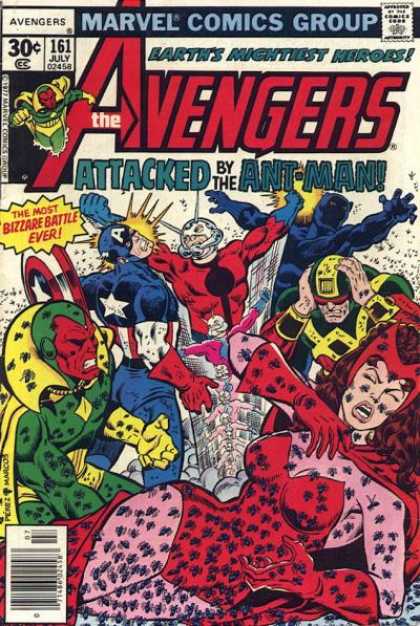
Karen: This also reminds me, I found some more ‘evidence’ against Byrne’s Vision: Back in Avengers 135, when we are witnessing the origin of the Vision, an enraged Ultron seeks out Horton, because he can’t make sense of the Human Torch. He expected to find wires and circuits, but did not. Now I guess you could say that never happened, since Byrne tossed out Immortus’ version of the origin.
Doug: Some of the high points we discussed during our Celestial Madonna review, such as the Vision at first awakening with the Torch’s conscious being, are “now” moot. And, as we also said earlier, it makes no sense in regard to Hank’s reaction to the Vision in Avengers #93.
Karen: But still…so much was overturned so Byrne could do ‘his’ Vision story. And get the original Human Torch back in action. That’s an obsession I really don’t understand.
Sharon: There were other ways to bring the Torch back; Byrne could have just said the Torch (or Vision) was from an alternate reality or time stream (similar to what occurred in #135, the issue you mentioned, Karen) or something. Or even if the Vision was indeed made from spare or similar parts, Byrne didn’t have to dismantle him and erase his established personality. And if Byrne so objected to Vision the family man, Byrne could have just done away with the children (as he did a few issues later); again, why was the Vision’s mental and physical dismantling necessary?
Karen: It seems as though he has a personal problem with the character.
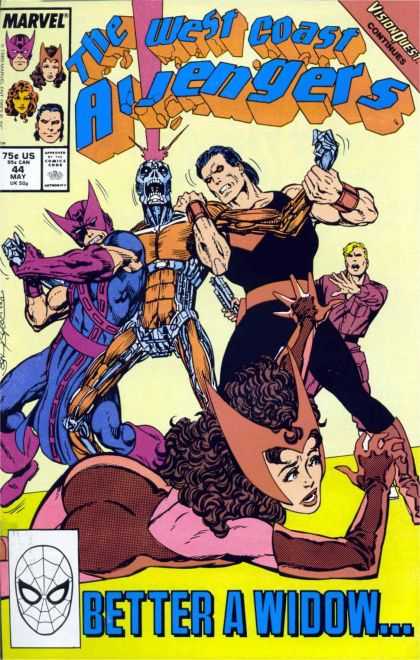
Sharon: West Coast Avengers #46 features a story about Hawkeye and the Great Lakes Avengers, then we return to the angst in #47 (now retitled Avengers West Coast…also, Solo Avengers was retitled Avengers Spotlight. This was done to make those Avengers titles sound more like the parent Avengers comic).
Doug: Wait, wait!! One more item of note concerning #45. This issue’s Bullpen Bulletins featured the return of Stan’s Soapbox! In this edition, Stan announced that Marvel had just been purchased by the same company that owned Revlon Cosmetics. Yeah, that worked out well…
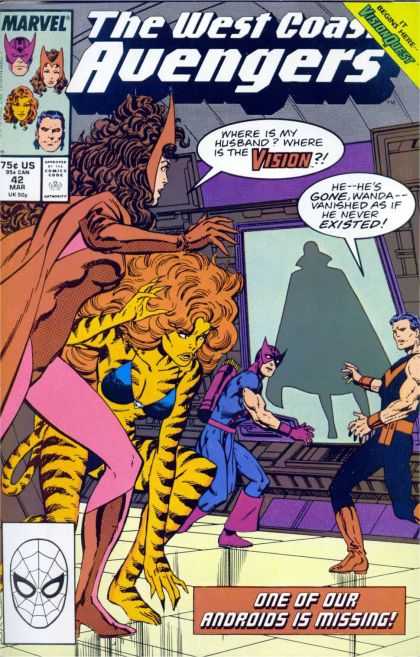
Sharon: The issue opens with Wanda pleading with Hank and T’Challa (who has just returned to the United States) to help her husband. Except for the obvious physical change, in T’Challa’s view, the Vision seems very much as T’Challa had remembered him. Wanda interprets this to mean that neither hank nor T’Challa are interested in helping the Vision regain his former humanity and she storms out.
Sharon: I was puzzled by T’Challa’s reaction. How could he not see a difference in the Vision’s manner? Look at the issues after the Vision joined the Avengers, when T’Challa was a fulltime Avenger; Vizh was always verbose and active…not passive and stoic as here. As an aside, Byrne draws a great T’Challa.
Karen: Byrne is re-writing a character and his history again. T’Challa has been around Vizh from the beginning. He should know better.
Doug: Agreed. Character assassination in a four-color sense. Seems more like what today’s authors do.
Sharon: For some reason, Wonder Man seeks out the Wasp and asks for her advice. The sagacious Jan already knows he’s in love with Wanda. Had Simon and Jan ever demonstrated this sort of friendship or closeness before? Did h
 e seek Jan out because she was the only female around and so only a woman would understand his feelings of love? Their discussion and plotting about how to get Wanda to see Simon for the great guy he is comes off as callous and appalling. Look, I’m a real sucker for tales of unrequited love and romantic triangles (and I can understand why Simon would fall for Wanda); but as Jan puts it their “former comrade” is “dead,” and I would think that sad fact would be foremost on Jan and Simon’s minds at this time—not how to get Wanda to see what a swell guy Simon is.
Karen: This was just terrible. I recall when I read it at the time I felt like I had no idea who these characters were! The fact that Jan admits on one hand that their old comrade the Vision is essentially dead, and then on the other hand, is scheming with Simon to win his widow, just turns my stomach. Were we expected to feel sympathy for Simon? It just made me dislike these two intensely for awhile.
Doug: Jan does come off as very amoral here.
Karen: I also felt that there really was very little acknowledgement by the Avengers that the Vision was basically gone. I mean, I was angry when Bendis had him torn apart and they just put him in a crate somewhere. But this really ticks me off too. The Avengers I knew certainly would not have let things go at this; they would have found some way to restore him. Hell, they could’ve given him Cap’s brain patterns! I mean, at least he’d have the capacity for emotion, even if his personality was not the same.
Sharon: Yes, I wondered about that too…why not use Hank’s brain patterns, since he’s right there and a smart guy --or was Pym afraid the Vision would turn out like Ultron? Okay, then how about T’Challa? Or as Karen said, Cap?
Karen: The worst thing about all this was that we got an extremely boring Vision for the next decade or so, and even though Busiek did a great job with him, it was too little too late. He never returned to the prominence he once had.
Doug: I agree, Karen. When you think of the face of the Avengers, and I’m talking about all-time, it has to be among these three characters: Captain America, Hawkeye, and/or the Vision. You can talk all you want to about Thor and Iron Man, but their tenures on the team have for the most part been brief and at long intervals in between. The above three were the mainstays of the classic team. You are right – the character was never the same again, not even (in my opinion) in the Busiek/Perez years.
Sharon: The Vision clearly dominated the series for many years. My question is, once Byrne left this series (about ten issues after this one), why didn’t later writers or editors redo the story and restore Vision to his former glory? The albino vision seemed to last an awfully long time. I don’t think this version was very popular with readers, was it?
Karen: It was a shattering turn of events for the character. It seemed to me like the character basically disappeared, although you would see him in panels of Avengers. He just didn’t get much play. Then we got into the Harras era…things got much better when Busiek came along, but again, no one really picked up the ball after him.
Karen: It seems to me a big part of Byrne’s message is that the Vision is not a person. While I will not argue that the Vision was human –as clearly he was not – I will argue that he had a soul. Whatever quality it is that we recognize as humanity, he had it. He could feel, he could make decisions, he had a sense of self, and a conscience. He was probably a better person than a lot of folks. To see him discarded this way – even 20 years later –really upsets me.
Doug: After having been through these issues again (for the first time since their publication), I am starting to come over to the “sentient being” side that you ladies have been pulling me toward. I still have a difficult time finding any physical relationship between the Vision and Wanda as acceptable, and I must say that at times Byrne was very convincing in his deconstruction of the synthozoid to the status of “simple” robot (he can be turned off, his memories had to be re-programmed, etc.).
Sharon: I’ve read that Byrne gleaned this angle from the ISAAC storyline, in which Vizh uploaded his mind into computers. So, Byrne reasoned, the Vision was really nothing more than a computer program.
Karen: I went to the Byrne Robotics forums and found these comments from Byrne. He obviously favors the Torch, although I find little to justify his beliefs:
“Androids (ie, artificial humans) tend to blur the line between living and non-living. Especially in a case like the Human Torch, where his origin tends to establish him as something much more than a clever assemblage of non-organic parts. The "instability" which originally caused him to burst into flame spontaneously indicates there's an unknown factor involved.
Push come to shove, I would put Jim Hammond into his own category, and grant that, altho he is "not of woman born", he is, in a true sense, alive. In other words, not a toaster.” (Nov. 19, 2006)
“The question becomes, I suppose, one of value. Knowing that the Vision's complete personality/memory/intelligence was downloaded into a computer in Titan (was it Titan? Memory blurs) allowed me to scrape his brain in my VisionQuest story, since everything could be restored with a literal flip of a switch. Should something that can be so easily copied and retrieved be treated as having the same intrinsic value as a human being? Should any of the human Avengers, for instance, ever risk their lives on behalf of the Vision? My vote would be no (as some of you have probably already guessed) -- but I would say that even if it were not possible to restore or "save" the Vision in any other way. He is a "toaster".” (Nov. 19, 2006)
Karen: What exactly is it about the Torch’s origin that somehow makes him worthy, and the Vision not? How do we know the Torch’s mind couldn’t be downloaded? I also don’t think he’s interpreting what happened with ISAAC exactly right. I do think though, that the ISAAC storyline by Roger Stern is when we began to see writers emphasize the Vision’s artificial aspects.
Doug: I don’t agree with Byrne’s rationalizing about saving/not saving the Vision. Even if one considered him to be some sort of accessory, he is no one’s “property”, so he goes beyond the notion that he is some simple resource. He is a being, albeit an artificial being; if the Avengers would ask him to lay his “life” on the line for them, then they should in turn show him the same sort of loyalty.
Doug: But what we are left with at the end of this long arc is in no way remotely the Vision we once knew – Buscema’s strong, brooding powerhouse. Noble, yet chillingly effective at disrupting the very life essence of an enemy. Leader, comrade, confidant. That’s my Vision.
Karen: My Vision will always be the one from the Kree-Skrull War, when I first saw him – an android who behaved like a man desperate to save the woman he loved. This was, after all, the hero who left the room to go cry after he was invited to join the team. I will always see him as a being of deep feelings, if often afraid or unsure how to express those feelings.











 Collect 'em all!
